Oil prices rise again nationwide amid the war in Iran. The war between the United States, Israel and Iran has reached a perilous new turning point. Your S&P and Nasdaq are now on track for their fifth straight negative week. Millionaires are made in markets like these. And the more the market panics, the bigger the opportunity. Especially if we can be greedy when everyone else is being fearful. So in this video, I’ll cover everything you need to know to actually take advantage of this crazy situation and get rich without getting lucky. Your time is valuable, so let’s get right into it. First things first, I owe you an apology. I’ve been getting tons of comments and messages asking me to cover the Iran war.
And honestly, I was staying quiet because there's just no end to the macro and geopolitical whirlwind that we're constantly in. Inflation, tariffs, trade wars, and now real wars. and I wanted to stay focused on the long-term fundamentals that actually matter for building wealth. But based on your reactions and the extreme fear in the broader market, I really should have covered this conflict sooner. So, that's on me. Let me make it up to you now by covering a few things that the mainstream media has been missing, like how this Iran war directly impacts Nvidia, AMD, and every other AI company on Earth, how long chip makers can hold out before their supply chains actually start to break, which companies are the most exposed, and which ones could come out on top, and of course, which stocks I'm buying as a result.
Alright, there's a lot to talk about, so let's start with what's actually happened so far. But instead of only focusing on oil prices, I'll show you the direct effects on AI and chip companies as we go. As I'm sure you know, the Strait of Hormuz is a narrow waterway between Iran and Oman that about 20% of the world's oil shipments pass through every day.
Table of Contents
1. Critical Resources for AI
2. Global AI Market Growth
3. Timeline of Conflict
4. Supply Chain Risk Exposure
5. High-Risk Companies
6. Micron and ASML Advantages
7. Possible Conflict Scenarios
8. Key Takeaways

Critical Resources for AI
Oil sets the baseline cost of moving everything, so when oil prices spike, shipping insurance and every energy-heavy part of the chip supply chain gets more expensive, which means the cost of every wafer, every chip, and every rack of GPUs goes up, and that drives margins down.
But oil is just one of five critical resources for AI chips and data centers that pass through the Straight, LNG (liquefied natural gas) is another, LNG powers the electricity grids in South Korea and Taiwan, where the overwhelming majority of all advanced chips on earth are made.
So, less LNG means higher electricity costs and potential power constraints for the fabs that make almost all the chips for Nvidia and AMD, Apple and Google, Tesla, and many more.
Helium is the third, it's used to keep machines and silicon wafers cool during lithography and to keep contaminants away from chips during deposition, without helium, fabs can't maintain the ultra-clean, temperature-controlled environments that they need to make the chips we invest in, there's no real substitute for helium here, this is a real choke point that others have already covered.
But sulfur also passes through the Straight, which gets refined into the ultra-pure sulfuric acid that's used to clean silicon wafers between manufacturing steps.
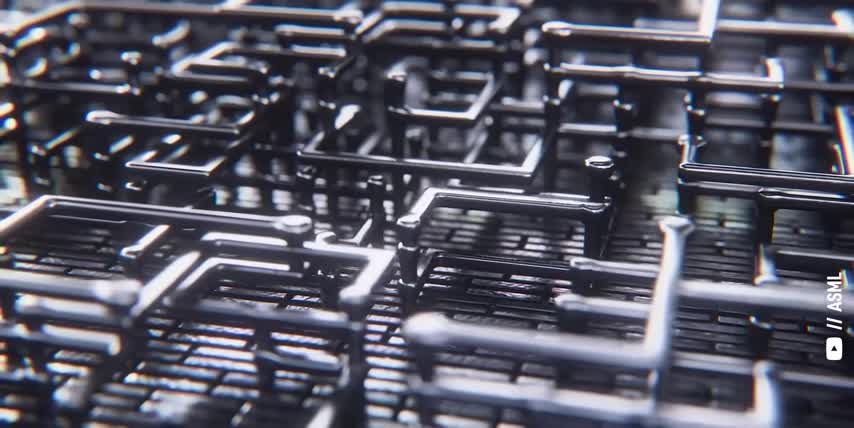
Sulfur is also used to extract copper from ore. And copper is literally in every chip, every board, and every cable in AI data centers. So a sulfur shortage doesn't just hit the fabs. It can also cascade into a copper shortage that raises costs across the entire AI buildout. And the fifth one is bromine, which almost never gets talked about. Bromine compounds are used in important chemicals inside chip fabs so disruptions here turn into disruptions in the lithography and etching process here's a table showing all five ai and semiconductor inputs that are seriously impacted by the iran war the point is this is way bigger than just oil prices and helium supplies a huge percentage of the world's lng sulfur and bromine are also at stake here and it's all happening in the middle of the fastest growth and most supply constrained period AI has ever seen.
Global AI Market Growth
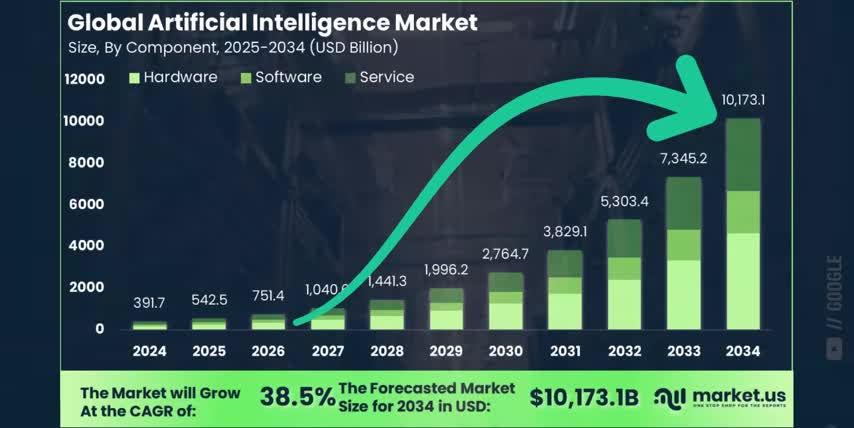
In fact, according to MarketUS, the global artificial intelligence market is expected to almost 19x in size over the next nine years which is a compound annual growth rate of 38 through 2034 But many of the companies building next generation AI applications are not publicly traded Think about the 90s and early 2000s. Companies like Amazon and Google went public very early in their growth cycle, but today they're waiting an average of 10 years or longer to go public. That means investors like us can miss out on most of the returns from the next Amazon, The next Google. The next NVIDIA.
But VCX by Fundrise gives everyday investors access to some of the top private pre-IPO companies on Earth. They have an impressive track record, already investing over $500 million in some of the largest, most-in-demand AI, infrastructure, and space launch companies. So if you want access to some of the best late stage companies before they IPO, check out VCX by Fundrise with my link below today. Alright, so while the growth opportunity for AI is massive over the long term, 5 critical supply chains feeding that growth are getting disrupted in the short term. Oil, natural gas, helium, sulfur and bromine. Now that we have that context, let's walk through what actually happened and when. That'll tell us how long chipmakers can actually hold out before their supply chains start to break.
Timeline of Conflict
February 28th, the US and Israel launch a massive strike on Iran. Oil prices spike and some people panic sell their stocks. But the broader market priced this in as a short-lived scare. That includes me, which is why I didn't cover it. The real clock starts on March 2nd, when Iran effectively closed the Strait of Hormuz, and Qatar Energy halted their natural gas and helium exports in the region. Roughly 20% of the world's oil and natural gas, around 30% of the global helium supply, and close to half of all seaborne sulfur and bromine stopped moving overnight. Every fab in Taiwan and South Korea is now on borrowed time, relying on shipments that were already in transit, plus whatever buffers they built up before the war.

Two days later on March 4th, Qatar Energy declares force majeure, warning their customers that they can't honor shipping and tanker contracts because of events beyond their control. Shipping insurance prices skyrocket, so sailing through the strait stops making economic sense altogether. Buyers in South Korea, Taiwan, and Europe start scrambling for new natural gas and helium contracts, now at much higher prices. South Korea's energy ministry begins emergency measures to conserve oil and gas, while Samsung and SK Hynix start drawing from their own helium reserves. Samsung and SK Hynix make most of the world's DRAM and high bandwidth memory, critical parts for AI data centers.
Things escalated again on March 18th and 19th, when Iranian missiles struck a NatGas facility in Qatar, knocking out around 17% of their export capacity for several years, not days or weeks, and constraining their helium production. For investors, that means that even if the war ends tomorrow, there will be a multi-year disruption to LNG and helium supplies that will last far longer than the headlines. A week later, on March 24, Qatar Energy expanded their force majeure declaration, warning customers in Italy, Belgium, South Korea, and China that there will be a sustained disruption to pre-existing supply agreements for natural gas and helium. Taiwanese and Korean fabs brace for higher and more volatile energy costs.
On March 27, Iran's Revolutionary Guard Corps officially closes the strait of hormuz for ships going to or from ports in israel the us and our allies that's also when the first round of major shipping data hit the news by the end of march not a single lng tanker passed through the straight and only a small fraction of the usual oil traffic was getting through all five supply lanes that i covered earlier oil liquefied natural gas helium sulfur and bromine are now disrupted. And that brings us to today.
Supply Chain Risk Exposure
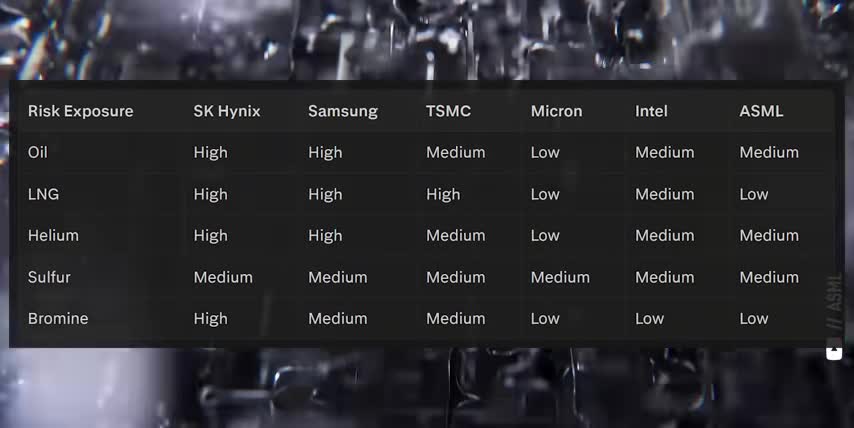
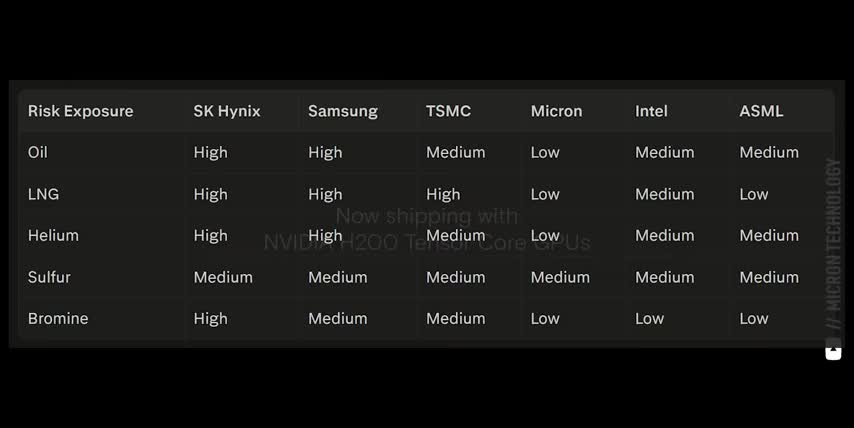
From now on every week that the Strait of Hermuz stays closed makes the size of stockpiles at companies like Samsung SK Hynix TSMC and even Micron start to matter more than their long contracts Alright, here's a table showing the estimated risk exposure based on everything we've talked about so far. Each row is one of the five critical supply lanes we just covered, and each column is a critical semiconductor company sitting in a different region of the world. Samsung and SK Hynix in Korea, TSMC in Taiwan, Micron and Intel in the US, and ASML in Europe. Almost every AI and chip company depends on at least one of these six companies, and any supply problems that these companies would have will ripple through the rest of the AI ecosystem.

A high-risk exposure means that if supplies stay disrupted, that company could face real production problems, not just higher costs. Low risk means they're mostly dealing with price increases, as opposed to the risk of not being able to secure those supplies at all. Oil, LNG, and helium are all high or medium risks for Korea and Taiwan, because they heavily rely on the supplies coming through Hormuz. Korean memory makers in particular are exposed to materials shortages and power disruptions as the war drags on. The risks are much lower for US companies like Micron and Intel.
They'll still see higher prices but they have access to more domestic energy and helium so the risks are mostly to their margins unless they pass those increased costs onto their customers and the same goes for asml in europe with higher energy and material costs.
Now that you understand how and where the supply chain is breaking let's talk about what that actually means for ai stocks and if you feel i've earned it so far consider hitting the like button subscribing to the channel and sharing this video that really helps the channel out and it lets me know to make more content like this thanks.
High-Risk Companies
Now let's talk about which stocks have the highest risks and which ones could come out on top like i just showed you samsung and sk hynix have the highest risks to their supply chains that's not just a problem for etfs like ewy which is ishare's south korea etf or dram which is roundhill's brand new memory etf that just hit the market.
These two companies are major suppliers of high bandwidth memory for nvidia's hopper blackwell and rubin gpus samsung also supplies some of the hbm chips for amd‘s instinct mi350s and over half of the hbm that goes into google's tpus through broadcom so if the war drags on companies like nvidia amd and google could start seeing supply chain issues for their memory chips.
As samsung and sk hynex keep juggling limited lng helium constraints and bromine supplies they'll probably cut their lower margin d-ram products first and do everything they can to protect their premium hbm lines but they might be forced to make some hard choices between protecting their margins or protecting their market share.
Tsmc is the other key company for almost every stock i cover on this channel all of the gpus and cpus for companies like Nvidia, AMD and Qualcomm are made by TSMC, as well as all of the custom ASICs for Broadcom, Marvell, Google, Amazon and Microsoft.

So if you own the stocks of any AI compute companies, chances are they're exposed to TSMC's supply chain risks. In practice, TSMC has a little more flexibility than Samsung and SK Hynix, because they reportedly have several months of helium reserves. They're already signing new natural gas deals and they have the pricing power to pass those higher costs on to their biggest customers. So, I don't think there's any real risk of TSMC actually shutting down. I think that wafer prices will go up and fabless chip companies will see their costs creep higher or have their allocations capped. That's a real headwind for sure but it's not as bad as a full stop to chip production.
Micron and ASML Advantages
Micron could be one of the biggest winners from this whole fiasco at least relatively speaking micron makes high bandwidth memory for amd's instinct mi350s for nvidia's blackwell and rubin gpus as well as dram and nand memory for qualcomm and broadcom and even flagship smartphones and major automotive companies unlike samsung and sk hynix micron has access to helium from north america and depends less on LNG that goes through the Strait of Hormuz On top of that they have record level margins and their products are heavily focused on data centers, so Micron is one of the few companies set up to survive these supply shocks and even pick up market share if the war lasts for a long time.
TSMC, Samsung, and Intel account for a majority of ASML's revenue, and Micron and SK Hynix drive a big chunk of their memory-related EUV business. So if CapEx shifts more towards lower risk regions or new fabs in the US, ASML is one of the few companies still getting paid. So if the war puts long-term pressure on supply chains to Taiwan and South Korea, semiconductor equipment companies like ASML, LAM Research, ticker symbol LCRX, and Applied Materials, ticker symbol AMAT, would end up on the winning side of this story. Now that you know where the supply choke points are and which companies they affect, let's talk about the three most likely scenarios going forward, and which stocks I'm looking to buy based on what actually happens next.
Possible Conflict Scenarios
I made a quick and easy table to break it all down for you. Scenario 1 is a near-term resolution, like a ceasefire or a partial deal in the next month or two. Shipments through the straight start ramping back up, and LNG and helium pressures come down before supply chains take too much damage. If that happens, the market will have overreacted on almost every stock we've talked about, and I'd expect to see a broad post-war relief rally in the market as fear turns into greed. Scenario 2 is a long-term, drawn-out conflict. The Strait of Hormuz never fully reopens, and some of the damaged gas and LNG capacity takes years to come back online. Samsung, SK Hynix, and even TSMC have higher input costs going forward, which puts pressures on their margins and on their customers.
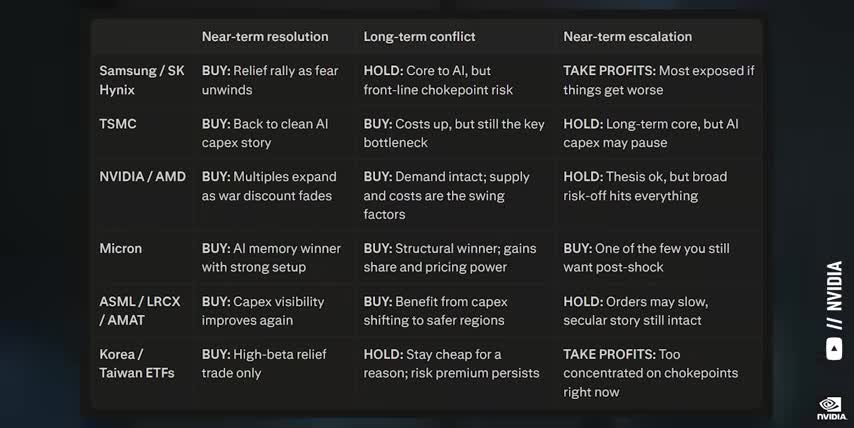
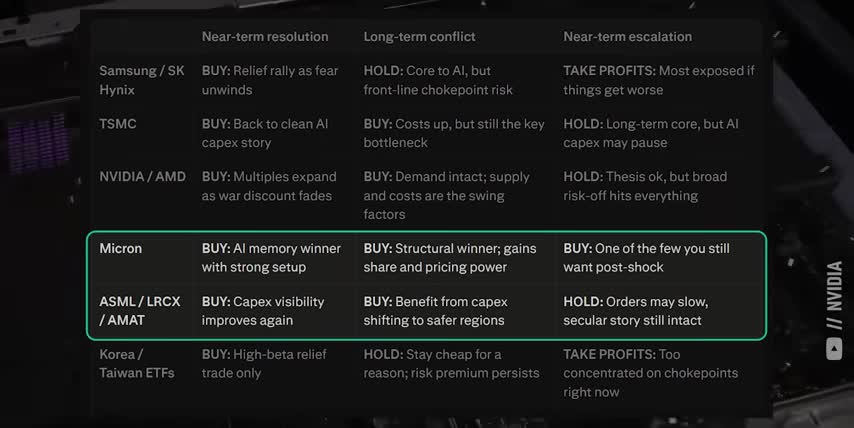
Korean memory companies and the ETFs built around them become higher-risk investments. TSMC and their big AI customers become more volatile but are still great long-term investments while companies like Micron, ASML, LAM Research, and Applied Materials come out on top as HBM stays in high demand and CapEx shifts towards safer supply chains. Scenario 3 is a near-term escalation, The opposite of scenario one. Oil prices keep spiking, more infrastructure is destroyed, and shipping through the strait becomes economically impossible. Institutional investors de-risk their portfolios, and even the best AI companies see their multiples go down. If that happens, I'm taking profits on my South Korean stocks. I'm building more cash, and I'm dollar-cost averaging less into the rest of my portfolio.
The only stocks I'd actively be buying in this scenario are Micron and maybe ASML. Micron's HBM4 capacity is already sold out for 2026 under long-term contracts and they're based in the US, which I think more companies will find very attractive if the situation escalates. ASML is the only real supplier of EUV lithography machines and their supply chain is much less dependent on the Strait of Hormuz. Hopefully, this video helped you understand that this war affects much more than just oil prices. There are at least five major resources that touch almost every stock in the AI ecosystem and that pass through the strait. Oil, natural gas, helium, sulfur, and bromine. The companies most at risk are the Korean high-bandwidth memory makers and their customers.
So that's where I'm being extra cautious until this conflict is fully resolved. That's when there could be a big relief rally. The companies with safer supply chains and real pricing power, like Micron and ASML, are the ones that I'm betting on, even if things stay the same or continue to escalate, making them a great way to get rich without getting lucky. Let me know in the comments if you want me to make a deep dive video on either of these companies, or what your plan is as the conflict continues. And if you want to see what else I'm buying to get rich without getting lucky, check out this video next. Either way, thanks for watching, and until next time this is ticker symbol you my name is alex reminding you that the best investment you can make is in you.
Key Takeaways
The Iran war has significant implications for the AI ecosystem, affecting not just oil prices but also the supply of critical resources such as LNG, helium, sulfur, and bromine.
Samsung, SK Hynix, and TSMC are among the companies most exposed to supply chain disruptions, which could impact their production and margins.
Micron and ASML may be relatively safer bets due to their access to domestic energy and helium, as well as their diversified supply chains.
Investors should be cautious and prepared for potential volatility in the market, with a focus on companies that can navigate supply chain disruptions and maintain their pricing power.
Checkout our YouTube Channel
Get the latest videos and industry deep dives as we check out the science behind the stocks.