Table of Contents
1. Introduction to Broadcom and Nvidia
2. Broadcom's Business Model
3. Broadcom's AI Revenue Growth
4. Broadcom's Earnings Report
5. Risks Associated with Broadcom's AI Business
6. Investing in Broadcom and Nvidia
Something big is happening at Broadcom that could mean big trouble for Nvidia. Broadcom's AI chip revenues more than doubled year over year, and they're quietly locking in massive deals with Google, Meta, OpenAI, and Anthropic. Could Broadcom be the next king of AI? And what does all this mean for Nvidia stock going forward? Your time is valuable, so let's get right into it. First things first, I'm not here to hold you hostage, so here's everything I'll cover in this post. What Broadcom actually does and how they make their money, how their AI hardware and software stacks up against Nvidia, what their latest earnings call tells us about the pace of the AI revolution, and of course, what all this means for Broadcom stock as a result. Broadcom is split into two big engines.
Broadcom's Business Model
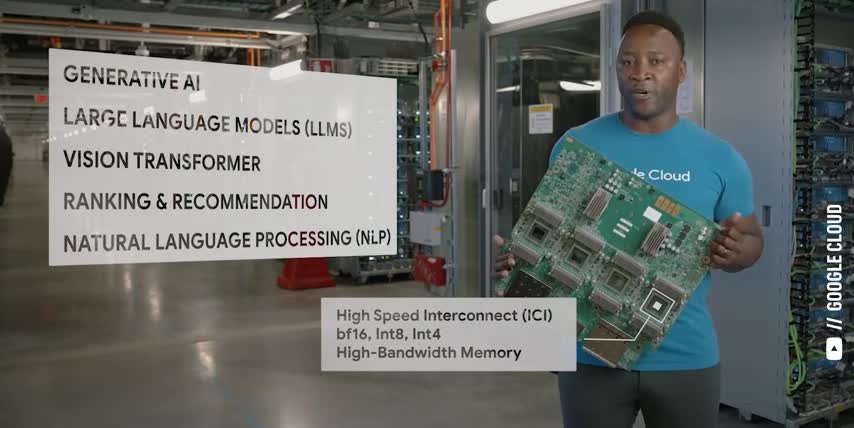
The first is chips and the second is software. On the chip side, Broadcom is a fabulous semiconductor company, which means they do the design and then send their designs to manufacturers like TSMC to actually build the chips. Broadcom's chips end up in AI data centers, networking equipment, storage systems, smartphones, and a whole lot more. The most important piece for investors is their AI and data center business. Broadcom designs custom AI accelerators for some of the biggest players in the game, including Google's TPU program, Meta's in-house AI chips, and newer deals with AI labs like openai and anthropic unlike nvidia's gpus broadcom's chips are made to order and tuned to every customer's models and infrastructure individually on top of that broadcom sells the high-speed nervous system that connects ai chips in data centers together specifically their tomahawk and jericho chips power ultra fast ethernet switches and routers that move data between thousands of ai accelerators if you've heard of million gpu or gigawatt scale ai clusters a lot of that traffic is riding on Broadcom's networking chips.
Their second engine is software, mostly because of VMware. VMware's platform lets companies run many separate virtual machines on the same physical servers and manage big workloads in their own data centers and in hybrid cloud setups in a single, consistent way. Since its acquisition, VMware shows up as Broadcom's infrastructure software segment, generating a lot of recurring revenue at very high margins. This combination of hardware and software is why Broadcom isn't just another chip stock. By providing the picks and shovels for a data center's physical layer and its control layer, Broadcom gets paid multiple ways every time AI infrastructure spending goes up. Speaking of which, let's talk about where Broadcom actually sits in the AI stack and how they compare to Nvidia.
Broadcom's AI Revenue Growth
At a high level, Nvidia sells general purpose GPUs and full-scale server systems that anyone can buy. On the other hand, Broadcom builds custom AI accelerators and networking for a small group of very large customers. Nvidia is the default choice for off-the-shelf AI compute. Broadcom is the company you call when you want your own chip, your own networking solutions, and more control over cost and performance. Last quarter Broadcom's AI revenues hit .4 billion, which is up 106% year over year. About one-third of that came from AI networking, while the other two-thirds came from custom compute. NVIDIA's GPUs are the gold standard for AI training. But Broadcom is quickly scaling a parallel set of chips that can be tuned for individual customers and locked into their long-term roadmaps.
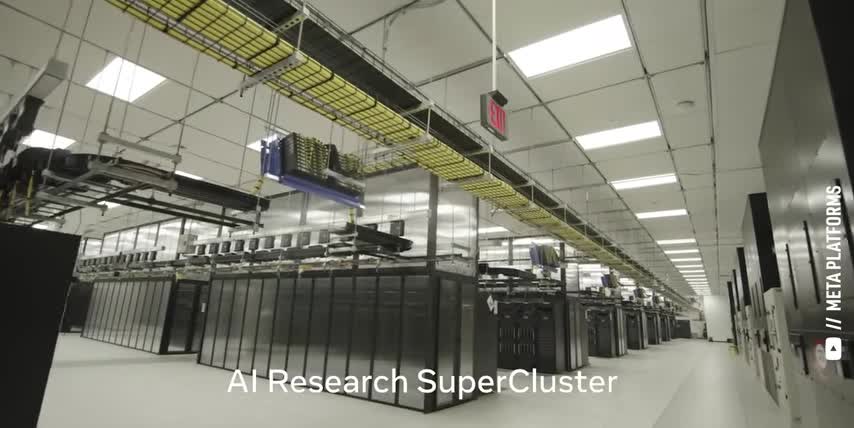
For example, Google uses Broadcom as the long-term co-designer for their TPUs, which train and run models like Gemini 3. And the latest Meta training and inference chips were developed with Broadcom as Meta tries to lower their own dependence on NVIDIA‘s GPUs. Anthropic took this even further, signaling a $21 billion multi-year deal for nearly a million TPUs and full-rack scale AI systems built by Broadcom, effectively turning them into one of Anthropic main custom compute partners On top of that OpenAI and Broadcom announced plans to deploy 10GW of custom accelerators confirming OpenAI as another flagship customer in Broadcom AI portfolio So Broadcom isn't just supplying parts around NVIDIA's systems, they're directly displacing GPU demand by giving hyperscalers their own custom silicon for these AI jobs.

Every chip deployed by Broadcom means less workloads running on NVIDIA's GPUs. Today, NVIDIA owns roughly 90% of the data center GPU market, making them the go-to solution for general purpose AI computing. But Broadcom owns roughly 70% of the custom AI accelerator market and around 80% of the market for data center Ethernet switch chips. In fact, networking is where the contrast is even sharper. Nvidia has its own InfiniBand and Spectrum X Ethernet stack, but Broadcom is the dominant supplier of high-end Ethernet switch chips through their Tomahawk and Jericho lines.
Broadcom's Earnings Report
Tomahawk is the high-bandwidth switch chip connecting GPUs and ASICs inside and across data center racks, while Jericho is the router that stitches together huge AI clusters, and even entire data centers into one massive compute system. like Arista Networks, Juniper, and even some Cisco switches are built around these chips. So Broadcom makes money even when data centers don't buy from them directly. So while Nvidia owns most of the AI infrastructure market today, big companies are turning to Broadcom when they want more performance per watt for specific applications and more control over their AI stack in general. That's why Broadcom's AI business is growing by 106% year over year.

Now that you know what Broadcom does and where they sit in the AI stack compared to Nvidia, let's dive into their earnings. Speaking of earnings, a new study shows that US workers who use AI every day earn 40% more than those who don't. That means AI is not optional. It's an advantage that you either have or others have over you.
And they're giving the first 1,000 people who sign up with my link a free seat. Whether you work in tech or sales, management or marketing, you'll learn how to use AI agents, create automated workflows, and connect them to the software and spreadsheets you already use every day. This is a great way to level up your AI knowledge, gain a real competitive advantage and understand the science behind the stocks. Over 10 million people all over the world have already attended and the slots for this one are filling up faster than ever. So make sure to register for your free seat with my link below today. Alright let's dive into Broadcom's earnings because this latest quarter is one of the clearest data points on where their AI business is really headed.

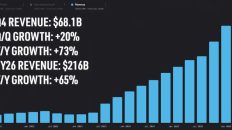
Broadcom reported $19.3 billion in revenue, up about 29% year over year, and just over Wall Street's estimate of $19.2 billion. And their gap earnings per share came in at $1.50, up from $1.14 a year ago. On paper, this looks like a normal beat, but under the surface, they're seeing massive growth thanks to AI. Out of that $19.3 billion, 8.4 came from AI. Like I said earlier, that's up 106% year over year. But it's also worth noting that AI now accounts for roughly 44% of Broadcom's total revenue. For context, AI is now a bigger share of Broadcom's business than AMD's, even though most investors still think of AMD as Nvidia's main competitor in AI. Broadcom's AI business is growing faster as well.
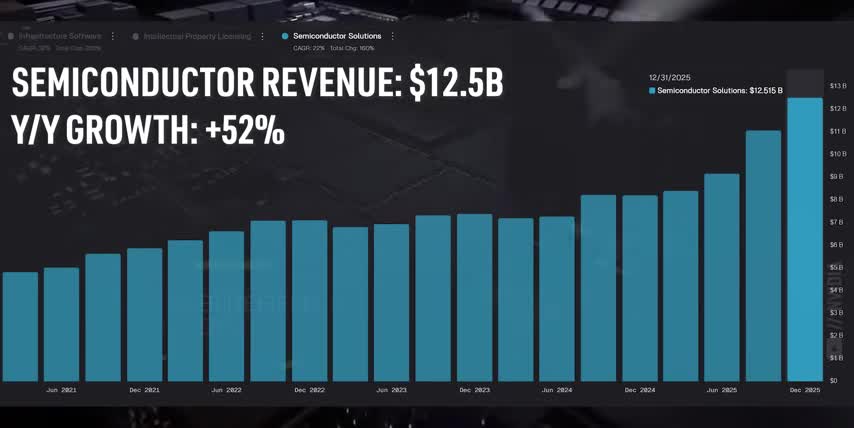
If we break things down by segment, Semiconductor Solutions did about $12.5 billion in revenue, up 52 year over year and it now represents around 65 of Broadcom total business Infrastructure software did the other 6 billion mostly thanks to VMware That only up 1 year but gross margins for the software side came in at 93%, with operating margins of 78%. So the growth is coming from AI chips, while software provides insanely high margins, which caused Broadcom's overall margins to also come in very strong. They reported gap gross margins of 68% or adjusted gross margins of 77%, 15 full percentage points higher than AMD and almost in the same ballpark as NVIDIA. Broadcom's operating margins came in at 66.4%, slightly higher than a year ago.

Risks Associated with Broadcom's AI Business
That means they're actually expanding their profitability while also ramping up their AI products and broadcom's free cash flows came in at eight billion dollars for the quarter or about 41 of their total revenues for context nvidia reported 51 free cash flow margins last quarter and amd reported about 23.
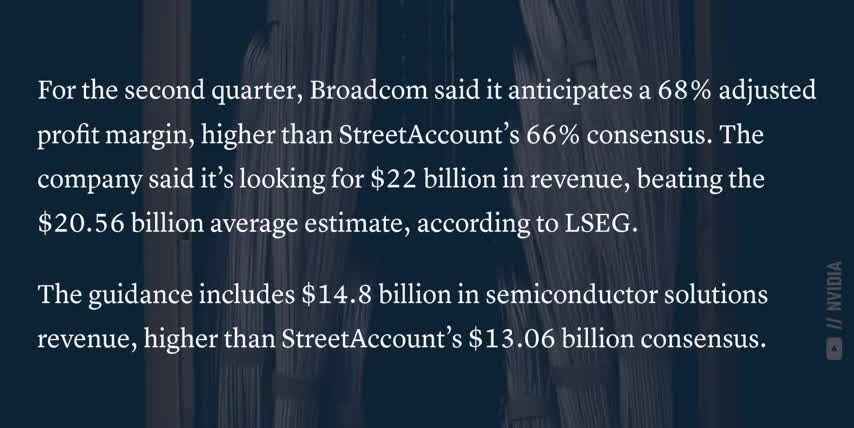
But broadcom's guidance is where their ai story really starts to stand out broadcom is guiding for about 22 billion dollars in revenue next quarter which would be 47 year over year growth and they specifically called out ai semiconductor revenue to reach about 10.7 billion dollars which would imply roughly 140 growth year over a year.
Said another way broadcom's ai revenues are expected to increase by 27 percent quarter over quarter and make up roughly half of their total revenues if they can actually hit these numbers for investors broadcom's earnings just confirmed three big things first ai is now the primary growth driver for their business.
Second they're scaling that ai revenue without sacrificing margins that most hardware companies would kill for and third their ai business isn't just growing it's accelerating which has big implications for the rest of the ai revolution for example broadcom ceo hawk tan told analysts that he has line of site to more than a hundred billion dollars of ai chip revenue in 2027.
And he was very explicit that this is chips only not software not services just semiconductors that implies that broadcom's ai chip revenue will more than double again by 2027 even from today's much bigger base of 40 billion dollars a year he also said that broadcom already secured their supply chain the wafers the advanced packaging and the high bandwidth memory to support that target.
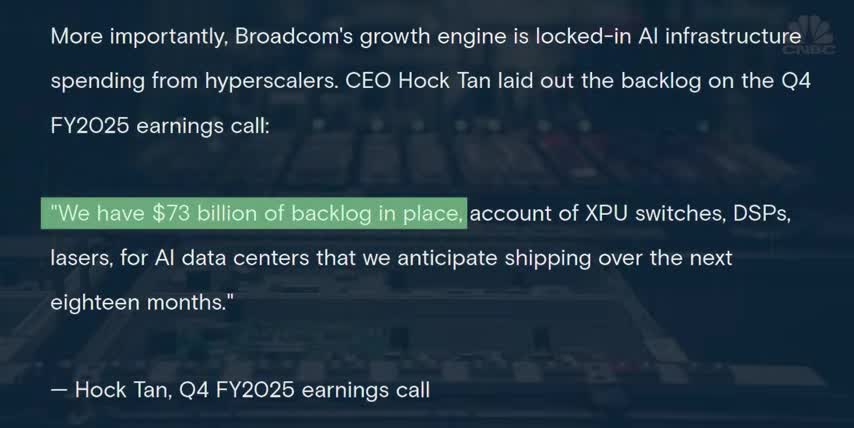
On top of that broadcom's total backlog is over 160 billion dollars including a 73 billion dollar backlog tied directly to huge orders from hyperscalers and ai labs for custom accelerators and ai networking products so a large part of their projected ai revenue growth is already under contract hoctan also mentioned that demand from google meta anthropic and open ai and other large customers is actually accelerating.
And that he expects AI to be the main driver for the growth of their semiconductor business for many years to come.
So if you're an investor trying to figure out whether we're close to the top of this AI spending cycle or we're still in the early innings of the AI revolution, Broadcom's backlog is saying we're still very early. It also reduces near-term execution risk because a lot of AI demand is already under contract and their supply chain is locked in but there are other kinds of risks that investors need to know about and if you're finding this post valuable consider hitting the like button and subscribing to the channel that really helps me out and it lets me know to make more content like this thanks now let's talk about the things that could actually break broadcom story if they go wrong the first big risk is customer concentration broadcom's ai revenue is heavily tied to a very small group of hyperscalers and AI labs like Google, Meta, OpenAI, and Anthropic.
Analysts estimate that Broadcom already controls over 60 of the custom AI chip market and their three largest customers could drive over billion in annual AI chip revenue by 2027 if the current roadmap holds. That sounds great, but even if one of their big customers slows down their spending, delays the deployment, or shifts more workloads back to Nvidia once they ship Verarubin at scale, Broadcom's growth could start to fall, and their stock price would fall with it. The second risk is margin pressure from the hyperscalers themselves. Custom chips have lower margins because they're designed for a single customer, over many years, with very high upfront research and development costs that usually get amortized over one customer instead of a much broader install base.
At the same time, hyperscalers have huge bargaining power, which puts a cap on the kinds of margins that Broadcom can make before customers simply switch to Nvidia. Broadcom and AMD effectively sell cost savings versus Nvidia, not a unique platform of their own like CUDA. And Broadcom's full rack-scale systems could lower margins even further. When Broadcom sells a complete AI rack, they bundle their chips and networking solutions with a lot of third-party components like memory, other kinds of processors, and sometimes even GPUs, all of which Broadcom passes through to their customers almost at cost. That means there's a big chunk of low-margin system revenue that sits on top of their higher-margin chip revenues.
NVIDIA doesn't have these problems because their GPUs are standard products that get sold to many customers, which means their R&D costs get spread over a much wider base. They also have a lot of pricing power thanks to the CUDA ecosystem, which customers can't really get anywhere else. And when NVIDIA sells a full system, most of the value is in their own hardware and software, with far fewer third-party components getting passed through to customers at low margins. At the end of the day, competing with Nvidia is going to be any AI company's biggest risk. But Broadcom's management sounded pretty confident on the latest earnings call, and they guided to 77% adjusted gross margins.
But the more their product mix moves towards custom AI, the more I'm watching for a drop in their gross margins over time. Alright, let's put everything together and see if Broadcom stock deserves a spot next to Nvidia in long-term AI portfolios. Like I've been saying for years, Broadcom is the only real competitor to Nvidia because they're going after different parts of the stack. Custom AI processors for a few key tech giants and the Ethernet switch chips connecting thousands of accelerators together. Nvidia owns roughly 90% of the data center GPU market, but Broadcom controls around 70% of the custom AI accelerator market and close to 80% of all Ethernet switch chips. That's what real competition in data centers looks like. But Broadcom doesn't have to be Nvidia to win big.
They just have to win the companies that don't want to fully depend on them. If hyperscalers keep spending hundreds of billions of dollars a year on AI infrastructure, Broadcom's $160 billion backlog will keep growing right alongside that spend. AI already accounts for 44% of Broadcom's total revenues today, and they expect it to more than double again in 2027. So, is Broadcom stock better than Nvidia? I don't think that's the right question. Broadcom is more diversified and gives my portfolio exposure to a different side of AI spending altogether. ASICs vs GPUs, Ethernet vs InfiniBand, and Custom Infrastructure vs Off-the-Shelf platforms. That way I win no matter which way the AI market goes.
But if you believe we're still in the early innings of this multi-year AI buildout, then Broadcom is a great stock to hold alongside Nvidia, not instead of it, making it a great way to get rich without getting lucky. And if you want to see what else I'm buying to get rich without getting lucky, check out this video next. Either way, thanks for watching and until next time, this is Ticker Symbol U. My name is Alex, reminding you that the best investment you can make is in you.
Key Takeaways
- Broadcom's AI chip revenues have more than doubled year over year, with a significant increase in custom AI accelerator sales.
- The company's AI business is expected to continue growing, with a projected 140% year-over-year growth in AI semiconductor revenue.
- Broadcom's total backlog is over $160 billion, with a significant portion tied to custom AI accelerator and AI networking product orders.
- The company's AI business is diversifying its revenue streams, with a growing focus on custom AI processors and Ethernet switch chips.
- Broadcom's management is confident in the company's ability to compete with Nvidia, with a focus on custom AI solutions and high-margin software sales.
- The company's stock price may be affected by risks such as customer concentration, margin pressure, and competition from Nvidia.
Checkout our YouTube Channel
Get the latest videos and industry deep dives as we check out the science behind the stocks.