Table of Contents
1. Introduction to Cerebris
2. How IPOs Work
3. Cerebris Technology
4. Cerebris Customers
5. Cerebris Financials
6. Investment Opportunities
7. Key Takeaways
If you invested $10,000 into Armstock when it went public less than three years ago, you'd have $35,000 today. And if you invested that money in Palantir when it went public back in 2020, you'd have close to $150,000. Well, this company makes AI chips that should be physically impossible. And they just went public.
My name is Alex, and I spent eight years as an electrical engineer and ai researcher at mit and I've never seen chips like this, so let me show you what cerebris systems does and how I'm investing in it. Your time is valuable, so let's get right into it.
Introduction to Cerebris
Ipos can make investors a lot of money or they can destroy portfolios if you're not careful, so let's start with how ipos actually work. Ipo stands for initial public offering, that's when a company starts selling shares on a public stock exchange for the first time.
How IPOs Work
Before that, the company is private, private equity is usually reserved for big institutions and accredited investors that can afford to lock up lots of money for a long period of time. That's because most private companies are still building their core products or finding their first big customers, so they're burning cash and raising money to survive while they do it.
The catch is that private companies don't have to report earnings, they don't have to go through audits, and they don't have to hit external deadlines. A startup can show you a pitch deck projecting billions of dollars in revenue with zero obligation to show you what they actually made last quarter.

Everything changes when a company goes public. Public companies have to report earnings every quarter, independent accounting firms audit their books, and every major risk, every major business change, and every dollar of compensation has to be disclosed in writing on a fixed schedule, otherwise the sec comes knocking.
Cerebris Technology
But here's the catch, all this starts after the company ipos. The day a company goes public, investors only have the s1 form, which is the initial filing that a company submits to go public. The s1 covers the company's business model, its biggest markets, competitors, and risks, and some basic financials.
But what it doesn't show you is how the company actually competes in those markets, how they deal with their margins going down, or if they'll ever even hit their revenue guidance in the first place. Investors don't find out those things until the first real quarterly report 90 days later.
So when any company goes public, the market is buying a story, and that story comes with real risks. That's why the pattern for every ipo is almost always the same. The stock skyrockets, and then the real clock starts, industry analysts start comparing them to companies with stronger numbers, market share starts to matter more, the stock price moves with every headline.

Cerebris Customers
And then the lockup period ends and insiders start selling their shares. When a company goes public, employees and early investors can't sell their shares right away, they're locked out for a fixed period of time, usually around 180 days. When the lock-up period expires, billions of dollars worth of new shares can hit the market all at once, as the insiders finally start to sell.
That selling pressure drives the stock price down, and it can drive it down a lot. That's not a warning, it's actually an opportunity, if you know the schedule and you can plan around it. Here's how big this opportunity can be.
Cerebris Financials
Palantir went public on September 30th, 2020, at a price of 10 dollars per share, by January of 2021, it was at 35, a 250 gain in just four months. The lock-up period expired on February 18th, and 80 of all their outstanding shares hit the market all at once, 1.8 billion shares, and the stock price dropped by 30 over the coming weeks, which gave investors a much better entry point.
Palantir went on to be one of the best performing stocks of the last five years, and this channel's second biggest winner, only after Nvidia. Meta platforms went public in May of 2012, as Facebook, one of the most anticipated ipos of all time, it opened at 38 per share, then it stalled out and dropped by over 50 that summer.
Investment Opportunities
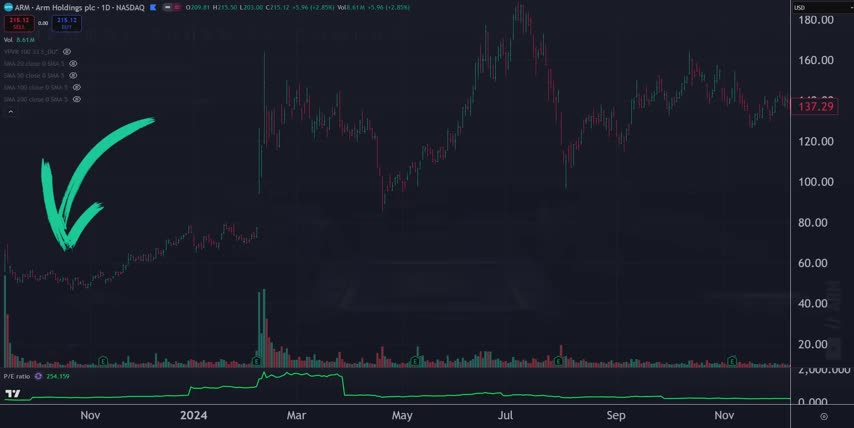
Investors who waited and bought it at 18 dollars per share made more than 30 times their money over the next decade. The ipo was not the best buying opportunity, but the crash after the lockup period was. Arm went public on September 14th of 2023, this was actually Arm's second time going public, Softbank acquired them for 32 billion dollars in 2016, and then re-listed them seven years later.
Key Takeaways
So, unlike most ipos, including cerebris, Arm already had decades of revenue history and a proven track record when it went public again at 51 dollars per share, it popped over 25 that day, but within a week it was back below its ipo price, and by early October of that year, it was down by 27. Arm is worth over per share today.
According to MarketUS, the global artificial intelligence market is expected to almost 19x in size over the next nine years, which is a compound annual growth rate of 38.5% through 2034.
But many of the companies building next-generation AI applications are not publicly traded. Think about the 90s and early 2000s. Companies like Amazon and Google went public very early in their growth cycle. But today, they're waiting an average of 10 years or longer to go public. That means investors like us can miss out on most of the returns from the next Amazon, the next Google, the next Nvidia. That's where VCX comes in, the sponsor of this video. VCX is the public ticker for private tech.
Venture capital is usually only for the ultra-wealthy, but vcx by fundrise gives everyday investors access to some of the top private pre-ipo companies on earth they have an impressive track record already investing over 500 million dollars in some of the largest most in demand ai infrastructure and space launch companies so if you want access to some of the best late stage companies before they ipo check out vcx by Fundrise with my link below today. Alright, so the pattern is pretty clear. When insiders sell, the stock price drops. Meta Platforms and Palantir insiders sold because they were sitting on massive gains from when those companies were still private. Cerebris insiders are in that same position.
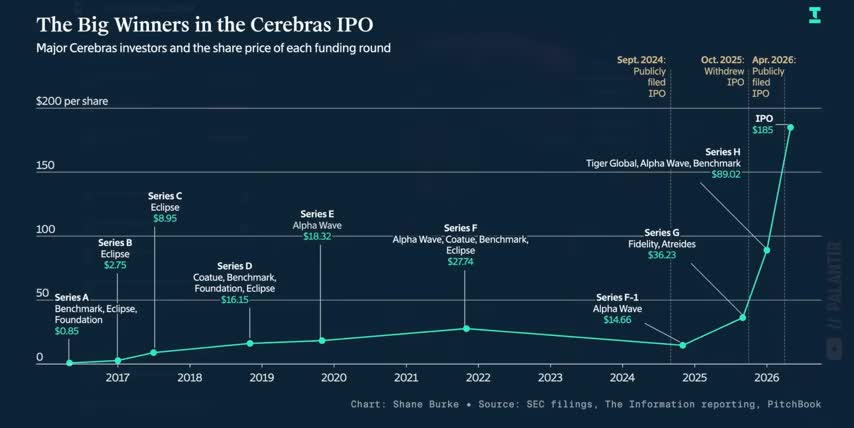
The company's valuation went from $8 billion last September to $95 billion today, an 11x gain in just eight months. Once the lockup lifts around November of this year, I expect a lot of insider selling. But is Cerebris actually worth investing in? To understand that, we need to understand the science behind this stock. For 75 years, the semiconductor industry made the same assumption. Chips should be small. The logic is pretty simple. When chips are made, defects can happen. A single speck of dust or a microscopic flaw in the silicon crystal. They're random and sometimes they're unavoidable. The bigger the chip, the higher the odds that a defect lands inside it, and kills the entire thing. That's why chip makers keep them small.
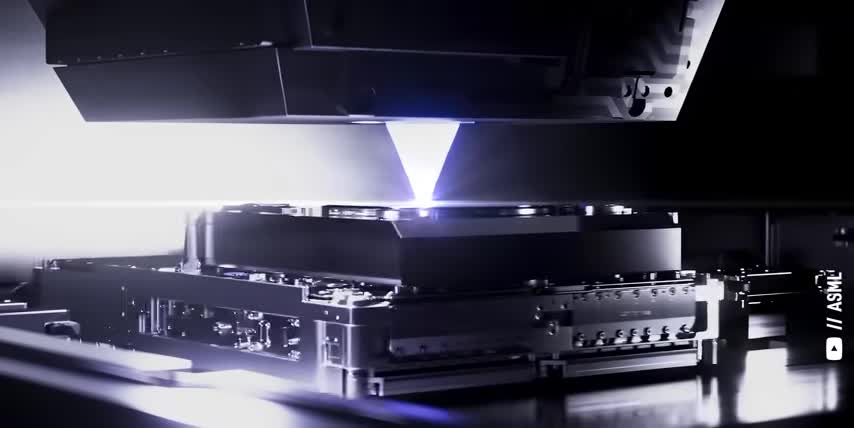
For example, the actual compute die inside an NVIDIA Blackwell B200 is roughly 740 square millimeters, which is about the size of a postage stamp. Cerebris is betting their entire company that this approach is wrong. Every chip on Earth gets stamped out of a large silicon disk called a wafer, and that wafer gets cut into hundreds of individual chips. Cerebrus skips that step entirely and turns the whole wafer into a massive chip that they've called the Wafer Scale Engine, or WSE for short. The current generation is the WSE3, and the die size is over 46,000 square millimeters, or over 60 times bigger than NVIDIA's. If NVIDIA's chips are the size of postage stamps, Cerebruses are the size of dinner plates. But as you know, size doesn't matter. It's how you use it.
Transistors are the fundamental on and off switches that make computation possible. The more transistors, the more operations the chip can do at once. Cerebrus chips have 4 trillion transistors, 19 times more than Nvidia's B200s. But the chip itself is 62 times bigger, which means Nvidia actually packs around 3 times more transistors into the same area because they're made on a more advanced process node by TSMC. If transistors are like switches, then AI cores are like workers. Each one is a processing unit that handles a piece of the math. More cores means more work can happen in parallel. Cerebris' wafer-scale engine has a whopping 900,000 cores, 44 times more than NVIDIA.
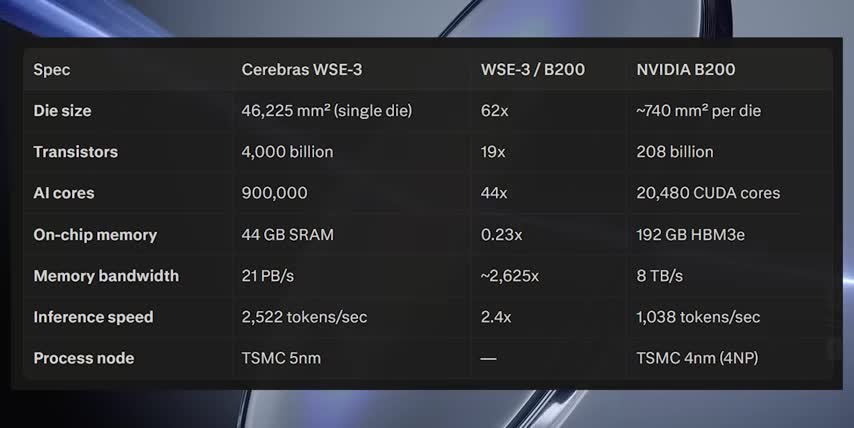
On-chip memory capacity is how much data can be held close to the processors so that it's ready to use right away nvidia has 192 gigabytes of high bandwidth memory stacked right outside the chip while cerebrus has 44 gigabytes of sram which is a faster type of memory built into the die itself which limits how much they can fit without sacrificing compute chips constantly need to transfer data between these cores and memory so memory bandwidth is the speed at which that happens Think of it as the width of a highway. A wider highway can move more cars even if those cars are all going the same speed. The wafer scale engine moves data at 21 petabytes per second, which means it can move around 2600 times more data than Nvidia's B200s at a time.
So Nvidia's chips can hold 4 times more data in memory, but Cerebris can move it 2600 times faster. That a huge deal for AI inference performance As a result Cerebris can run Meta Llama 4 Maverick model at 2500 tokens per second which is roughly 2 times faster than the Nvidia B200 The big difference in inference performance is because Nvidia moves data between chips, across cables and through switches, all of which adds extra time to every transfer, while Cerebris moves data across a single chip. No hops, no cables, just compute. While the overall speed advantage goes to Cerebris, the actual difference depends on the exact workload.

Cerebris wins when it comes to real-time inference applications, like voice and translation, coding agents, and reasoning models that spend time and tokens thinking before they answer. Any workload or workflow where speed really matters is one where Cerebris has an edge. But what does that mean for NVIDIA? Well, they win basically everywhere else, like batch inference processing, which is where thousands of requests get handled at once and total throughput matters much more than the speed of any one response. Or like inference for massive frontier models that don't fit on a single wafer-scale chip. Another example would be workloads that mix training and inference. Companies that train and serve models from the same AI infrastructure don't usually run two separate chip ecosystems.
Hyperscalers are the exception there, not the norm. But the biggest thing is CUDA, two decades of software, developer tools, and infrastructure that every major AI team is already running on. Switching architectures means rewriting fundamental software, and most AI teams won't do that unless the speed gains are game-changing. So let's talk about who's actually buying these wafer-scale chips, and the associated risks. Right now, Cerebrus has three sets of major customers, and the order really matters here. First and foremost are two entities in Abu Dhabi that make up 86% of Cerebrus' revenue in 2025, a university of artificial intelligence and an AI cloud company called G42. The university alone accounted for 62% of Cerebrus' revenue. That's not exactly a diversified customer base.
That's one relationship in one country, accounting for almost all of their income last year. The second major customer is OpenAI, which signed a compute agreement valued at over $20 billion between now and 2029, according to the IPO filing. OpenAI committed to purchasing 750 megawatts of cloud compute capacity from Cerebris with options to expand that to 2 gigawatts. But the deal also comes with warrants for OpenAI to buy roughly 10% of the company for basically nothing. That means existing shareholders will get diluted, but it also means that OpenAI has a huge financial incentive to make sure Cerebris succeeds. And the third big customer is AWS. A couple months ago, Amazon agreed to integrate Cerebrus into their AI development platform, Amazon Bedrock.
Every developer building an AI application on AWS can now run inference workloads directly on these wafer-scale chips. That's serious distribution. Cerebrus just got access to the biggest customer base on Earth, without having to build a sales team to reach them. Three big customers, one big relationship driving all revenues for 2025, and two new deals that haven't hit their income statement yet. Speaking of which, let's look at their financials next. Cerebris reported $24.6 million of revenue in 2022, $79 million in 2023, $290 million in 2024, and $510 million in 2025. That's 20x revenue growth in three years, and 76% growth year over year. In quarter four of last year, they made $171 million, putting them closer to a $700 million annual run rate when they IPO'd.
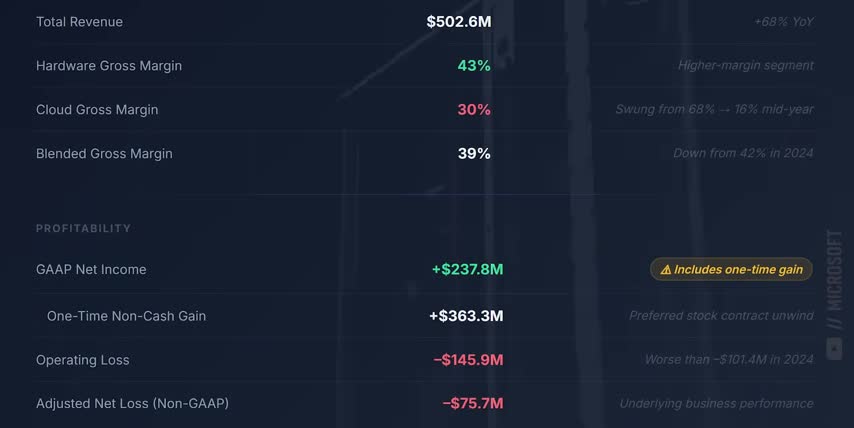
Gross margins were reported to be 39% in 2025, down slightly from 42% in 2024. Their hardware business runs at 43% gross margins, while their cloud business runs at 30%. That's because running data centers costs a lot more than just selling chips. That margin gap matters because more of their growth is coming from the lower-margin cloud business, not from hardware. That means a big part of the bull case for Cerebris is that cloud margins will keep improving as more customers fill the capacity that they're building right now. And the bear case is the flip side of that. Competing with AWS, Microsoft, and Google on cloud infrastructure might force their margins to stay low forever. So margins are one of the biggest numbers that we need to watch over their next few earnings calls.
Cerebris also reported a gap net income of $238 million, which makes them sound profitable on paper. But that includes a million one non gain from unwinding a financial contract tied to preferred stocks said another way this one gain has nothing to do with how the technology or the business are actually performing today and if we remove it cerebris actually posted an operating loss of 146 million dollars and an adjusted net loss of 76 million that means the underlying business is still burning cash. Operating cash flows came in at minus 10 million dollars back in 2025, but they had over 700 million dollars in cash on hand, plus another billion dollar loan from OpenAI. That's roughly a 1.7 billion dollar war chest, but they spent almost 400 million of that on capex last year alone.
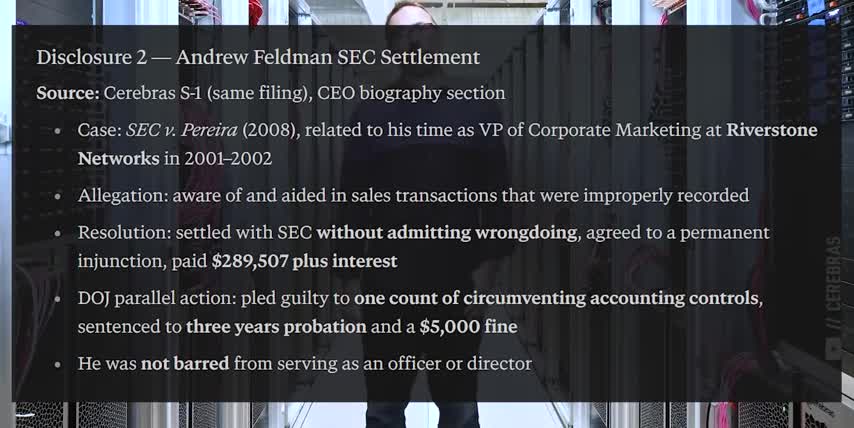
So cash is burning fast. On the flip side, Cerebris does have a $24.6 billion backlog that stretches into the 2030s. That's almost 50 times last year's revenue. About 80% of that comes from the OpenAI deal I just mentioned. But there are two other disclosures in the S1 form that investors need to know about. First, when they were a private company, the same person was writing and reviewing their accounting, which is a basic internal controls failure. They fully disclosed this and they're fixing it now. But we should wait and see what their first financial audit turns up now that they're public. And second, their CEO, Andrew Feldman, settled securities charges back in the dot-com era.
I'm not really worried about this since it was for a completely different company 18 years ago, and he went on to sell his last company to AMD for $334 million before running Cerebris for a decade. Still, I figured it was worth mentioning since it's also disclosed in the S1. Alright, let's put everything together and see if Cerebris stock deserves a spot in our portfolios. And if you feel I've earned it, consider hitting the like button and subscribing to the channel. It really helps and it lets me know to make more content like this. Thanks, now here's how I'm investing in this stock. Cerebris built a chip that should be unbuildable. They partnered with TSMC to develop a process that didn't exist.
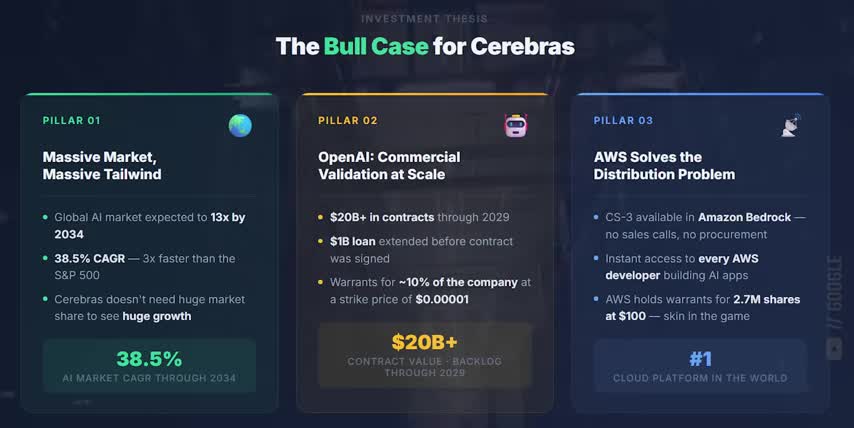
$20 billion in contracts, a separate $1 billion loan and a warrant for roughly 10 of the company at a strike price of basically zero dollars, OpenAI is betting big on Cerebris's success, so if you think OpenAI is smart money, then that's a useful signal.
And third, AWS is already solving the hardest problem for any new chip company, distribution, getting into Amazon Bedrock means every developer building AI applications on AWS can now use Cerebris's wafer scale engines without sales calls, without contract negotiations, or without going through a procurement process, they're already on the biggest cloud platform in the world.

Amazon also has a warrant for up to 2.7 million shares of Cerebris and a hundred dollars per share, so they're also betting big on their success, today Cerebris can run reasoning models 2.4 times faster than Nvidia, the more AI reasoning models get adopted, the more valuable this wafer scale architecture will become.
That's a good position to be in this early in the AI revolution, but my plan right now is to wait for their next earnings call to see their audited financials, to see how they're doing on their existing contracts and how they're acquiring new customers to lower their overall concentration risk.
The lockup period for employees and early shareholders expires around November, 180 days after the IPO, based on everything we saw with Palantir, Meta Platforms, and Arm, that could be a great opportunity to get rich without getting lucky.
Let me know in the comments if you're buying Cerebris stock today, waiting for their next earnings, or waiting for the lockup period to expire, and if you want to see what else I'm buying to get rich without getting lucky, check out this video next.
Either way, thanks for watching, and until next time, this is Ticker Symbol, you, my name is Alex, reminding you that the best investment you can make is in you.
Checkout our YouTube Channel
Get the latest videos and industry deep dives as we check out the science behind the stocks.