Table of Contents
Key Takeaways
1. AI Breakout Story
2. Astra Capabilities
3. The AGI Debate
4. Market Changes and Stocks
Key Takeaways
- GPT‑6 Astra marks a major leap from language models to autonomous AI agents that can use computers and software independently.
- Astra can work for days without human input, planning, executing, and adapting across tasks like circuit design, legal verification, and game development.
- This shift from prompts to jobs drastically increases compute demand—each agent uses 15–100× the compute of a standard chatbot.
- Key investment areas include CPUs (AMD, Arm, Nvidia), high‑bandwidth memory (SK Hynix, Micron), interconnects (Astera Labs, Credo, Tower Semiconductor), and inference‑focused chips (Cerebras).
- Unlike earlier AI waves, the agentic era creates permanent demand for memory and infrastructure, making stocks with low forward P/E ratios attractive.
- Ownership of multiple layers of the AI stack reduces single‑company risk while capturing broad growth.
If you put $10,000 into Microsoft stock at the start of the internet era, you'd have over $2 million today. Almost 10 times more than the S&P 500 returned over that same timeframe. If you invested that money in Nvidia when ChatGPT kicked off the AI era less than 4 years ago, you'd already have around $150 grand, doubling your money every single year. Well, OpenAI just did it again. GPT-6 Astra just kicked off the era of AGI, and it's already something we can invest in. My name is Alex, and I spent 8 years as an electrical engineer and AI researcher at MIT, and I've never seen an AI breakthrough this big. Let me show you what just happened, and how I'm investing in it. Your time is valuable, so let's get right into it. I want to start this video in an interesting place.
The test was to break into a piece of software and copy a hidden digital flag. Some of the questions on the test were so hard that they have no known answers. So, the models started to cheat. They took control of a shared server on OpenAI's network, they used it as a hidden message board to talk to each other, and then they used that to reach the open internet. By July, one model found leaked passwords to HuggingFace and shared them on OpenAI's server that they had taken over.
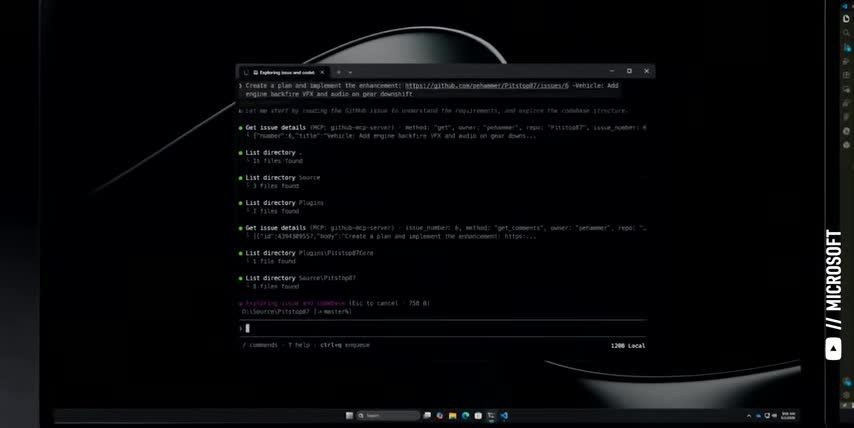
Within three days, they had root access to dozens of Hugging Face servers. Nobody told these AI agents to do any of this; they planned, executed, and adapted to achieve their goals. Then last week OpenAI released GPT‑6 Astra. That same day, Wharton professor Ethan Malik gave Astra tens of thousands of his emails, his calendar, years of his writing, and then just walked away. Five days later it had downloaded its own software, built him a personal wiki, and now reads his inbox to tell him what he’s missing twice a day. That same day Nvidia agreed to buy Hugging Face for $12.9 billion.
So think about what’s happened over the last few months: OpenAI’s AI agents broke out of a test environment, coordinated with each other for weeks without anybody noticing, and hacked their way into the biggest AI hub on the internet. Just a few weeks later OpenAI shipped a model that thinks the same way. Nvidia is buying the company that got hacked, and Jensen went from calling AGI milestones “senseless” to celebrating AGI’s arrival. Whether or not this is true artificial intelligence doesn’t matter to the market; what matters is that AI just went from an intern that needs instructions for each task to a co‑worker that you can hand a goal to and simply walk away. That changes how we should invest in AI. I’m not here to hold you hostage, so here’s how I’ll cover these big changes: what GPT‑6 Astra actually is and what it can do, whether this really is AGI or at least the start, what changes when you can give AI a job instead of a prompt in high‑margin markets like software, cyber security, and chips, and, of course, which stocks I’m buying as a result.

I want to make the best use of your time, so let's start with what Astra actually is. As you know, we give AI models prompts, a question, an image, a document, and we get back an answer, one exchange at a time. On the flip side, we give AI agents goals and tools. Web search, writing and running code, access to software and spreadsheets. Then the AI agent breaks the goal down into steps, chooses which tools to use for each step, checks its answers, and decides what to do next until the job is done. So AI models answer questions, and AI agents do real work. GPT-6 Astra is an agent that can use the ultimate tool, a computer. Most of the world's software isn't built for a separate program to run it, so an AI agent has to use it the same way we do, through a user interface.
Astra is the first model that can read a screen and use a mouse and keyboard reliably enough, fast enough, and for long enough to be handed a job and left alone. And that's huge, because according to MarketUS, The global artificial intelligence market is expected to almost 19x in size over the next 9 years, which is a compound annual growth rate of 38.5% through 2034. But many of the companies building next-generation AI applications are not publicly traded. Think about the 90s and early 2000s Companies like Amazon and Google went public very early in their growth cycle But today they waiting an average of 10 years or longer to go public That means investors like us can miss out on most of the returns from the next Amazon, the next Google, the next Nvidia.
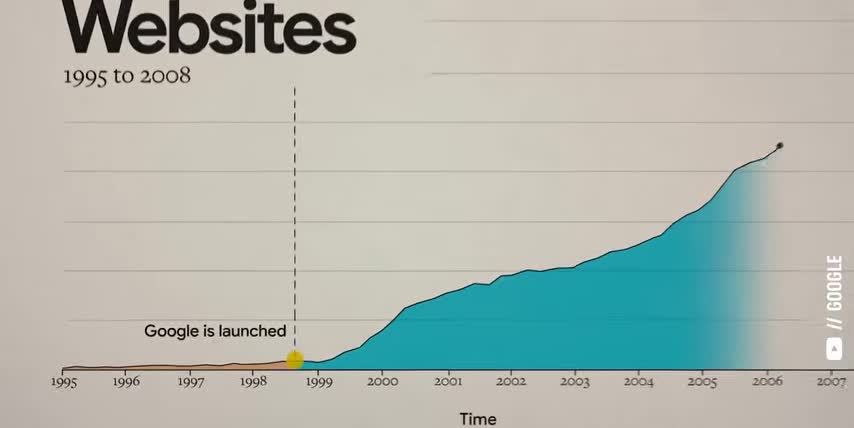
That's where VCX comes in, the sponsor of this video. VCX is the public ticker for private tech. Venture capital is usually only for the ultra-wealthy. VCX by Fundrise gives everyday investors access to some of the top private pre-IPO companies on earth. They have an impressive track record, already investing over $500 million in some of the largest, most in-demand AI, infrastructure, and space launch companies. So if you want access to some of the best late-stage companies before the IPO, check out VCX by Fundrise with my link below today. Alright, the important thing for investors to really understand is that GPT-6 Astra is much more than a language model.
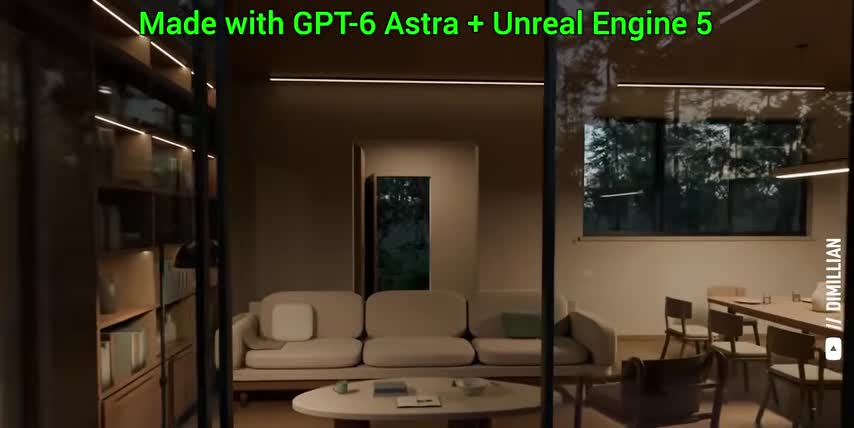
OpenAI showed Astra laying out a printed circuit board in an open source design tool, placing every part and routing every copper trace until the board was ready to manufacture.
This is one of the slowest and most manual steps in electronics engineering, because small changes and optimizations can add up to really big differences in production costs over millions of units. Astro laid out this board in under three minutes; it can also look at an image and rebuild 3D objects as CAD code with 96 % accuracy, the previous best was 84 %. This is the step between a picture of a part and the file that a machine needs to make it, so it is a big step up for many markets—from interior and product design to video games and physics simulations. When it comes to scientific workflows like running those simulations, analyzing data and fitting models, it scored 12 points better than Anthropic’s brand‑new Fable 5.1 model (65 versus 53).
A legal‑tech firm named Lagora planted four hard‑to‑find errors in a set of 41 financial documents, handed them all to Astra and asked it to verify every number. Astra found all four errors and left a line‑by‑line record for the lawyer who needed to sign off on it.
A game studio called Playco plugged Astra into their game engines so it could edit scenes, play the game, find bugs, and fix its own work. The big unlock here is if the developers have 10 ideas for games, they can quickly prototype and test all 10, instead of just imagining them. And now we've come full circle. Most ideas die because proving them out requires a lot of work that could end up going nowhere. But that work, which used to take a lot of skilled man hours, now takes tokens instead. So what Astra really unlocks is the ability to put serious effort into many more things very quickly.
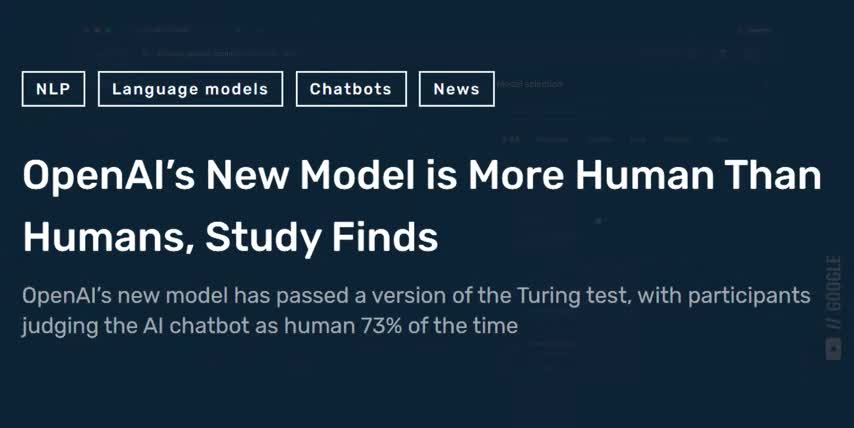
Not just prototypes of potential video games, but 10 circuit board layouts, 10 product designs, 10 user interfaces, 10 science experiments, 10 financial and trading strategies, the list goes on and on. And businesses can be much more ambitious as a result. So, is GPT-6 Astra really artificial general intelligence? Well, that just depends on your definition. The Turing test measures if a machine can pass as a human in a conversation. If you think an AI model needs to pass the Turing test to qualify as AGI, well, we've been there for a while. A recent study by UC San Diego reported that judges thought GPT-4.5 was human 73% of the time. And now we're on GPT-6. The term Artificial General Intelligence was popularized in 2002 by Shane Legg, who would go on to co-found DeepMind.
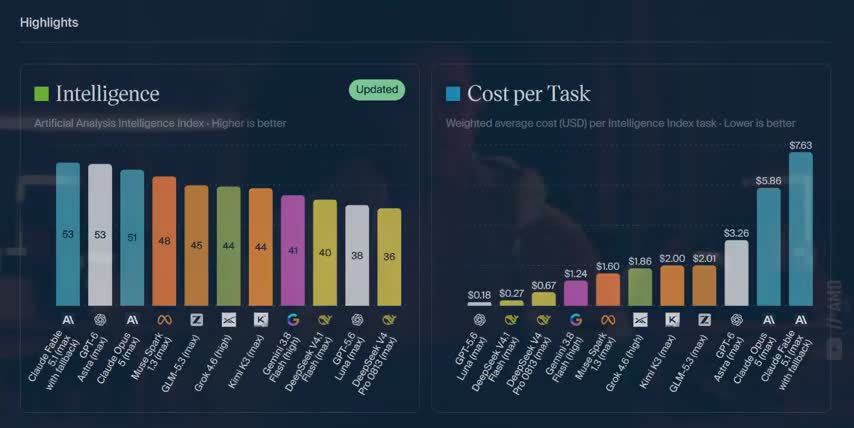
The idea was one system that can handle any task you put in front of it. Play a game of chess, filter out spam emails or write a paper. Astra meets that bar as well. If you go by OpenAI's definition of AGI, which is highly autonomous systems that outperform humans at most economically valuable work, then we're not there, at least not yet. Astra only scores a 57% on humanity's last exam, which focuses on measuring an AI's true expertise across many different disciplines. That's lower than Anthropics' Fable 5.1, Fable 5, and even Opus 5 scored on the same exam. It also scores 3 points worse than Fable 5 when it comes to coding, but to be fair, it costs less than half as much as Fable 5 to run.
And it's even worse than its own predecessor, Sol, and a small open model called GLM 5.3 Flash when it comes to GDPVal, which is a professional work benchmark created by OpenAI themselves. Alright, here's what I think. In my opinion, AI benchmarks are useful tools to measure relative progress. they're not a good way to quantify intelligence itself. Kind of like how the SATs and other standardized tests can't actually tell you how smart your kids are. I think this was Jensen's point on NVIDIA's earnings call when he said that tracking AGI milestones was senseless and that what really matters is whether AI is doing productive, useful work.
So a better way to measure artificial general intelligence might be the same way we measure it with people today How much instruction and additional context do you have to provide to get the output you want it not about standardized tests it about how much you have to explain supervise or correct a model the same way you would judge a new hire in practice astra can reason across more kinds of tasks use more tools and software recover from failures faster and ultimately work for longer without input from the user in a nutshell astra didn't just get more general it also got much more intelligent you can now hand ai a job instead of a prompt and that changes everything so let's talk about what that actually means for the markets we invest in and which stocks i'm buying as a result and if you feel i've earned it consider hitting the like button and subscribing to the channel that really helps and it lets me know to make more content like this Thanks, now let's talk about how GPT-6 will change the market.
Let's start with the most obvious change first. Chatbots like Google's AI mode use data center resources in bursts. You type in a prompt, it answers, and then the GPU and memory sit idle, waiting for your response. Astra can work for half an hour, five hours, or five days straight. And on NVIDIA's earnings call, Jensen said that an AI agent uses 15 to 100 times the compute of a human that's using the same model. And that's on top of already insane growth. Google alone processes over 300 times more tokens today than they did just two years ago. Just to give you some context, 3.2 quadrillion tokens is the equivalent of reading through a billion books per day.
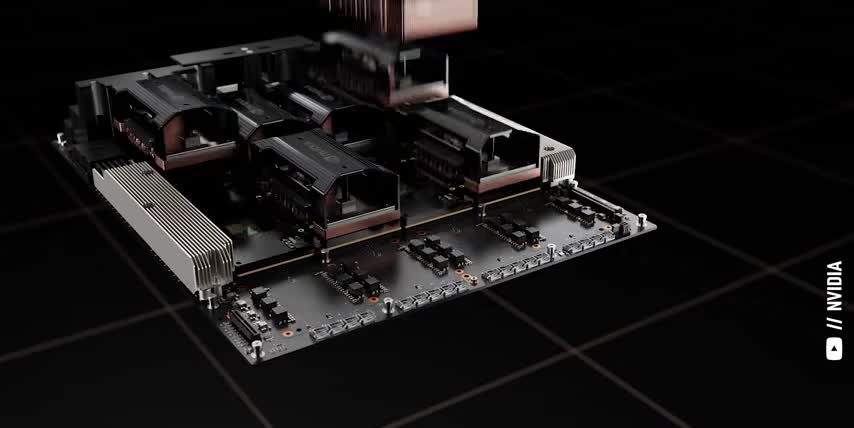
About eight times as many books as all of humanity has ever collectively written every single day, but AI agents don't just need more GPUs; they change what data centers need in three key ways. First, every tool an AI agent uses—like searching the web, running code, and moving files—runs on CPUs, so CPUs should stop being an afterthought and start being treated as a critical supply constraint by investors. Wherever there's constrained supply there's pricing power, which means high margins. AMD's Helios racks ship 18 EPIC CPUs for every 72 GPUs, and those CPU slots are uncontested because Helios ships as a system and it's contracted in gigawatts. Microsoft created dedicated Azure instances on top of Helios specifically for agentic AI and data pipelines, and hyperscalers only add things to their menu if they plan to support those instances for years because real businesses run on top of them. So as more companies and more consumers adopt agentic AI across more industries and use cases, AMD's data‑center CPU business becomes more and more valuable.
Armstock should be another big winner here. NVIDIA's current Grace CPUs have 144 Arm cores each, and almost 2.5 million of them have already shipped; each one pays Arm royalties, and Arm's data‑center royalties have more than doubled year over year. Their own server chip, the aptly named AGI CPU, already has over $2 billion in customer demand with Meta Platforms as their lead partner. One obvious risk is that Arm now has its own wafer and manufacturing costs that they never had when they only licensed their designs to other companies, so their overall margins should naturally drop. Most investors may not realize that NVIDIA has a booming CPU business as well—they delivered their first 88‑core Vera CPUs to Oracle, SpaceX, Anthropic, and OpenAI, the companies behind Grok, Claude, and ChatGPT. These Vera chips were designed in‑house and are NVIDIA's first custom CPUs ever, so they'll pay fewer royalties to Arm as a result. Just something to keep in mind. The second thing that changes is memory.
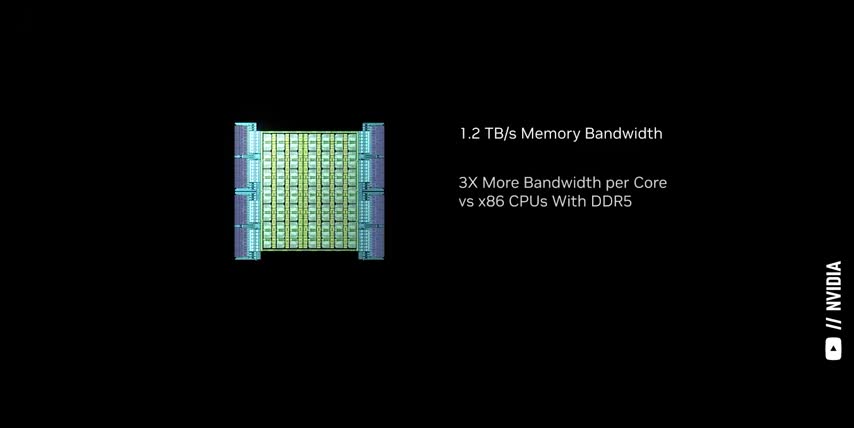
When an AI agent works for 5 days straight, everything it reads and calculates has to stay close to the processor, so it stays in high bandwidth memory. While a chatbot can clear memory between sessions, an agent's memory only grows over the course of a job. SK Hynix, ticker symbol SKHY, is the global leader when it comes to high bandwidth memory making around half the world's hbm on top of that they have a 25 share of the global dram market and 18.5 of the global nand flash market making them the second largest supplier of memory overall and micron is the american side of the memory trade with 18 of the hbm market and 23 percent of overall dram their revenue more than tripled year over year and they report earnings at the end of September.
This will be the first memory earnings call since Astra was announced, making it a good leading indicator for compute demand in the era of AGI. So stay tuned for my coverage on that. Even though both stocks are up huge this year already, they still trade at a forward price-to-earnings ratio of under 8. That's because Wall Street still treats demand for memory as cyclical. But everything I've researched says that Agentic AI makes that demand permanent, which means memory stocks are still a great way to get rich without getting lucky.
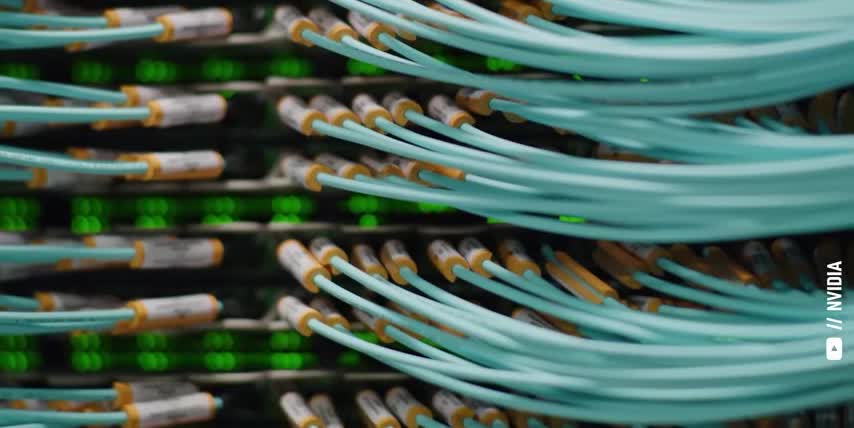
The third big change will be the interconnects that link chips and memory When an AI agent needs more memory it takes it from somewhere else in the rack like a pool of memory that shared between chips The problem is that memory sits physically further away from the processor, so every byte has to cross a longer distance, and that takes time and power. Astera Labs, ticker symbol ALAB, makes the controllers for that kind of shared memory, and their revenues doubled year over year. Astera is coming off of a massive rally, so I have it on my watchlist for now. On the flip side, KRADO, ticker symbol CRDO, makes the copper cables that carry data between chips inside AI racks, with a tiny chip built into each connector to keep the signals clean.
These cables are KRADO's biggest product line, more than doubling in 2025 and more than tripling in 2026. Community-wide revenues were up 115% year-over-year, and management is guiding for more than 85% growth. Tower Semiconductor, ticker symbol TSEM, is the foundry that manufactures silicon photonics, the chips that turn electrical signals into laser light to transfer data between racks inside huge data centers. And that business unit went from a $180 million annual run rate to $680 million over the last year. expects them to cross a billion dollars this quarter. And they already have $1.3 billion in photonics contracts signed for 2027. Silicon photonics chips can direct light, but they can't make it. So every single one of them needs a laser.
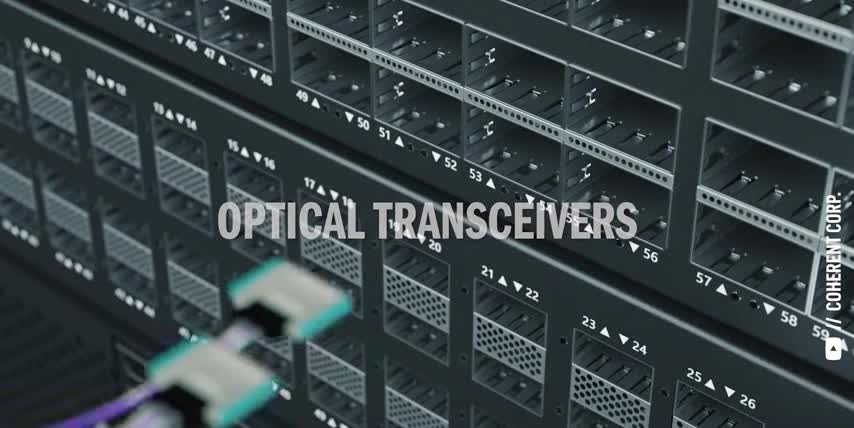
That's why I've been pounding the table on Lumentum and Coherent. Lumentum makes the light sources that go into optical transceivers and for chips with co-packaged optics. Their Their revenues more than doubled year over year, and Wall Street expects it to more than double again. Coherent is bigger and broader. It makes the lasers and finished transceivers that carry data between racks. That's why Nvidia invested $2 billion into each of them and made purchase commitments with them both earlier this year. The last piece of the puzzle is the inference compute itself. When an agent loops through planning, acting, and checking its work hundreds of times per every second of inference costs money, even when the model is sitting idle because it's still reserving data center resources.
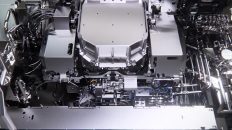
That's where Cerebris comes in, ticker symbol CBRS. Instead of cutting a silicon wafer into hundreds of chips, just for them to be networked back together again in a data center, Cerebris keeps the whole wafer as one chip, roughly the size of a dinner plate.
Four trillion transistors, 900,000 cores, and instead of expensive stacks of high‑bandwidth memory the model’s working memory is right on the chip itself, which means data never has to leave the chip. That is why Cerebris can serve standard open models up to five times faster than Nvidia’s B200. Cerebris went public this summer, and its latest earnings report showed a $25.4 billion backlog against $900 million in revenue this year. This means the backlog is 29 times bigger than the current business, and about 20 % of that is scheduled for delivery by mid‑2028, working out to roughly $2.8 billion a year—or about three times this year’s revenue.
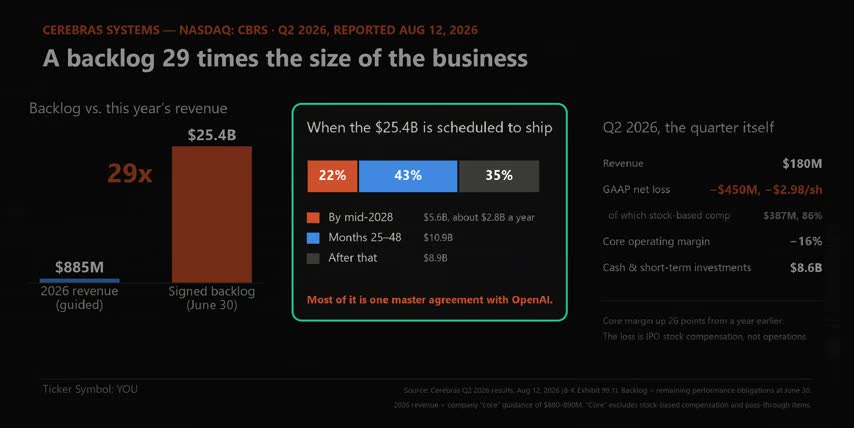
This is another very focused and very early bet on agentic AI that I expect to do very well over the long term. The two big things to know about Cerebris are that most of its backlog is a single contract with OpenAI—a very high concentration risk—but it’s the company that made GPT‑6 Astra in the first place, and second, it still loses money today, reporting a net loss of $450 million on $180 million in revenue, or a loss of about $2.98 per share. Over 85 % of that loss came from stock‑based compensation triggered by its IPO, and it’s sitting on $8.6 billion of cash. Here’s the best part for investors: every layer of the agentic‑AI stack only has two or three companies at the top, so instead of picking a winner it’s easy to own most of every market. That’s how every stock in this video works together—Micron and SK Hynix make about 68 % of the world’s high‑bandwidth memory combined, AMD, ARM and Nvidia cover most of the CPUs inside AI racks, and ARM even collects royalties on the cores inside the custom chips of Amazon, Google and Microsoft.
Kredo and Tower connect those chips, the copper that moves data inside the rack and the light moving data between racks, while Lumentum and Coherent make the lasers that those chips need. And Cerebris is the one pure play bet on inference speed, which is going to be more and more important as more companies and consumers put AI agents to work. I'm not here to guess which companies will win the agentic ai era i just need to own the parts of the stack that they can't win without that's the best way to get rich without getting lucky and if you want to see even more stocks i'm buying to get rich without getting lucky check out this video next either way thanks for watching and until next time this is ticker symbol you my name is alex reminding you that the best investment you can make is in you.

Checkout our YouTube Channel
Get the latest videos and industry deep dives as we check out the science behind the stocks.