Table of Contents
1. Nvidia's Record Revenues & Margins
2. The Broadening AI Buildout (ACIE)
3. CoreWeave: The NeoCloud Leader
4. NeoCloud Comparison & Verdict
Key Takeaways
- Nvidia's record earnings reveal a broadening AI buildout beyond hyperscalers, with the ACIE segment growing 138% YoY.
- NeoClouds (CoreWeave, Nebius, IREN) are strategically positioned with direct Nvidia partnerships and multi-billion dollar contracts.
- CoreWeave offers the most scale and active power, making it a lower-risk bet for exposure to the AI infrastructure boom.
- IREN presents the highest upside potential due to its low enterprise value relative to contracted power, but carries execution risk from its Bitcoin mining pivot.
- Nebius sits in the middle with the strongest balance sheet and fastest revenue growth, but trades at a premium valuation.
Nvidia just had their best earnings call ever, but not for the reasons that you might think. Whether you're a long-time shareholder, or you're just trying to figure out if we're in an AI bubble, you should know that this earnings call wasn't just about revenues or profit margins. Nvidia showed us exactly where the AI revolution is headed next, and which stocks will win big as a result. My name is Alex, and I spent 8 years as an electrical engineer and AI researcher at MIT, which helped me find great stocks like Nvidia, Micron, and TSMC years before the rest of the market. So let me show you where AI is headed next and how I'm investing in it to get rich without getting lucky. Your time is valuable, so let's get right into it.
Nvidia's Record Revenues & Margins
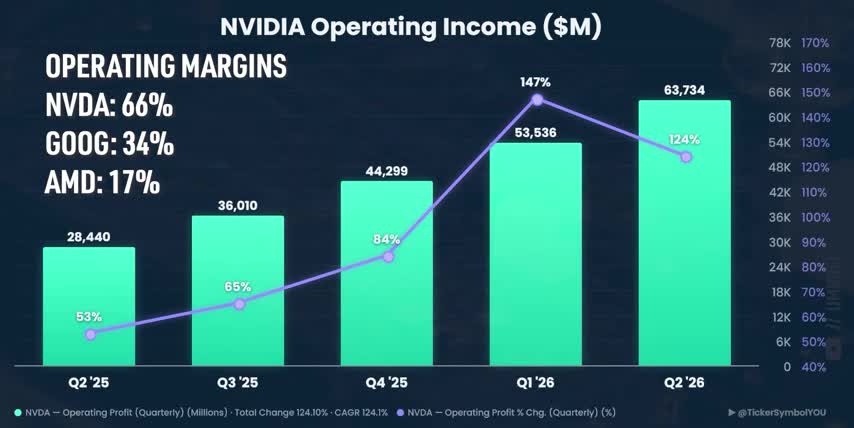
Nvidia reported earnings just a few days ago, on August 26th, and since they sit at the very center of the AI revolution, their earnings reveal a lot more than how much money they made. It tells us where that money is coming from, how fast it's moving, and where it's headed next. So, let's start with that. Nvidia reported record revenues of .2 billion for the quarter, which is up 18% quarter over quarter and 106% year over year. So right off the bat, AI spending isn't slowing down. It's accelerating. Nvidia's year over year revenue growth was 62%, 73%, 85%, and now 106% over the last four quarters. Even better, their operating expenses only grew by 55%, or around half as fast as their revenues.
As a result, NVIDIA's operating income shot up 124%, giving them a whopping 66.2% operating margin. For context, Alphabet's operating margins are 34% and AMD's are around 17%. So, said another way, for every dollar they all make, Nvidia keeps twice as much as Google and almost four times as much as AMD, which are two of their biggest competitors in the AI chip market. There are lots of interesting things in Nvidia's earnings that probably warrant separate videos, like the fact that their earnings per share more than doubled, but about 15 percent of that growth actually came from .8 billion in gains on Nvidia's investments into other AI companies, which is up from .2 billion a year ago, or the fact that they more than doubled their supply capacity commitments from 9 billion last quarter to 9 billion today, primarily to lock in memory for Vera Rubin this year and Rubin Ultra in 2027.
That tells me that memory stocks will keep selling every single chip that they make over the next few years. So the main metric to watch for memory stocks is how much they can increase their production capacity. Let me know in the comments if you want me to make a full post diving into Nvidia's earnings and what they tell us about every downstream AI market. But the big thing I want to focus on today is one specific change to how they report their data center revenues. Last quarter, Nvidia stopped reporting data center revenues as a single number and started reporting them as hyperscale versus ACIE, which stands for AI clouds, industrial, and enterprise. We all know the hyperscale companies: Microsoft, Amazon, Google, and Meta Platforms.
That means that ACIE includes everyone else, from healthcare and financial services, to automotive and robotics companies, and from government and sovereign AI buildouts to AI cloud providers. There are two important facts about this category. First, ACIE grew by 138% year over year, while Hyperscale grew by 102%. This is the first time that Hyperscalers weren't the fastest growing segment, which means the AI buildout is broadening, well beyond the trillion-dollar tech giants, and that broader spend is growing even faster.

And second, this category includes the neoclouds specialized ai infrastructure providers like coreweave, nebius and iren, which are the focus of this video. One of them is the pretty clear winner and I'll show you which one. When we compare them there are three big reasons to focus on neoclouds above other kinds of companies, at least for the near term. First, they have deals with every kind of ai buyer—from startups like perplexity and figure ai all the way to the hyperscalers themselves. That means that even their direct competitors are their customers; microsoft alone has multi‑billion‑dollar contracts with all three neoclouds, and meta platforms signed a 21 billion‑dollar contract with coreweave and has a contract with nebius that's worth up to 27 billion dollars.
Second, nvidia itself is directly partnered with all three of these companies. Over the next five years nvidia is on the hook to buy any unused compute capacity from coreweave and use iron's infrastructure for their own internal workloads under a 3.4 billion‑dollar contract. On top of that nvidia can buy up to 2.1 billion dollars worth of iron stock as they deliver GPUs, and they've already invested 2 billion dollars each into coreweave and nebius. Investing in companies backed by the biggest player in AI and the most valuable company on the planet is a great way to lower your overall risk and get rich without getting lucky. And third, this entire category is on track to almost triple in size.

Nvidia expects its NeoCloud partners to finish 2026 with 8 gigawatts of installed capacity, up from roughly 3 gigawatts at the end of 2025. This is actually a virtuous cycle, because more compute capacity means more companies and consumers can use AI more often and for more use cases, which means more demand, which causes the AI build-out to grow even faster. When people ask me which AI tool I open first, they're surprised when I don't say ChatGPT or Claude. They're great, but the one that actually helps me the most is Whisperflow, the sponsor of this video. Most people talk way faster than they can type, especially with their thumbs. Whisperflow is a super fast, high-quality voice-to-text tool that acts kind of like a keyboard replacement.

whisper flow is free to try but you can get one month of pro with unlimited words by using my link in the description all right so core weave nebius and iron are worth covering first because they're expected to triple their capacity over the next year they're all directly partnered with Nvidia and even their competitors are their customers let's start with core weave ticker symbol CRWV since it's the biggest of the three core weave operates 51 data centers purpose-built for ai across north america and europe they have 1.5 gigawatts of active power and 4.2 gigawatts of power under contract we care about both numbers when we compare the neoclouds because they mean different things active power is the electricity actually flowing into servers that are running today while contracted power is the promise of future electricity to a site that may not even be built yet.
this distinction matters because investors look at active power to gauge current utilization and revenue, whereas contracted power signals growth potential and long‑term market share. core weave’s strategy leans heavily on securing large contracts early, often locking in power at favorable rates before building out the physical infrastructure. this approach reduces risk of over‑capacity and aligns cash flow with expansion plans, making the company an attractive play for those betting on the rapid scaling of AI workloads.
Only active power actually generates revenue. Nvidia's Blackwell racks hold 72 GPUs each, and they take around 120kW to power. That means CoreWeave has enough contracted capacity to power over 30,000 racks, or more than 2.2 million Blackwell GPUs.
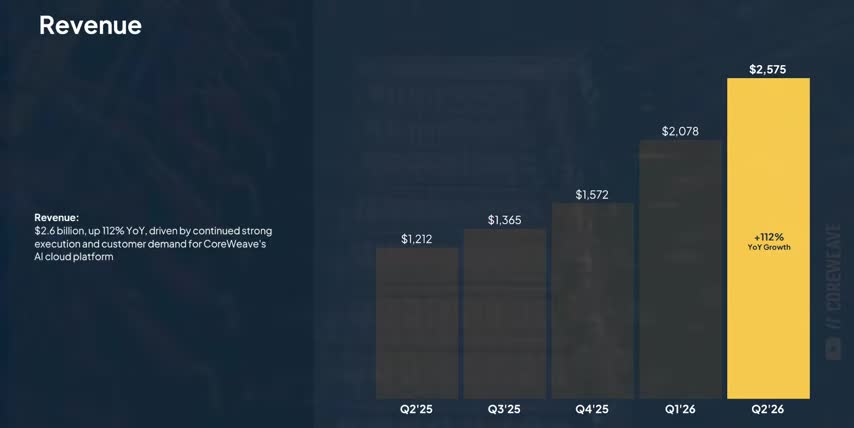
Then they sell access to those GPUs either as bare metal chips or full‑stack instances that are managed through a cloud control pane that lets CoreWeave spin up clusters of GPUs, add in low‑latency networking and storage, and schedule large AI workloads—all without touching the physical servers. On their latest earnings call CoreWeave reported record revenues of $2.6 billion for the quarter, up 112 percent year‑over‑year, but, as I’ve been saying for over a year now, the special thing about CoreWeave isn’t just the revenue growth; it’s their revenue backlog, which just reached $104 billion, up 246 percent year‑over‑year.
That growth is mostly driven by multi‑year, multi‑billion‑dollar contracts with massive companies like OpenAI, NVIDIA, Microsoft, and Meta Platforms. In fact, Meta alone signed another $21 billion deal with CoreWeave back in March. Another special thing about CoreWeave is their privileged relationship with NVIDIA—CoreWeave is basically the launchpad for NVIDIA’s latest chips.
Last quarter, they were the first to validate NVIDIA's Verorubin racks, including the Bluefield 4 DPUs and next-generation networking solutions that help make sure that all these expensive GPUs are being fully utilized. And like I said earlier, they have a formal $6.3 billion partnership where NVIDIA will purchase any unsold cloud capacity from CoreWeave through April of 2032. Earlier this year, NVIDIA and CoreWeave also agreed to build out more than 5 gigawatts of ai factories by 2030 enough to power millions more nvidia gpus as part of this deal nvidia invested another 2 billion dollars into core weave stock at 87 per share that's actually higher than the stock trades today so anyone buying it now is getting a better price than jensen huang himself speaking of prices there's one insanely important number that determines whether a NeoCloud survives or thrives.
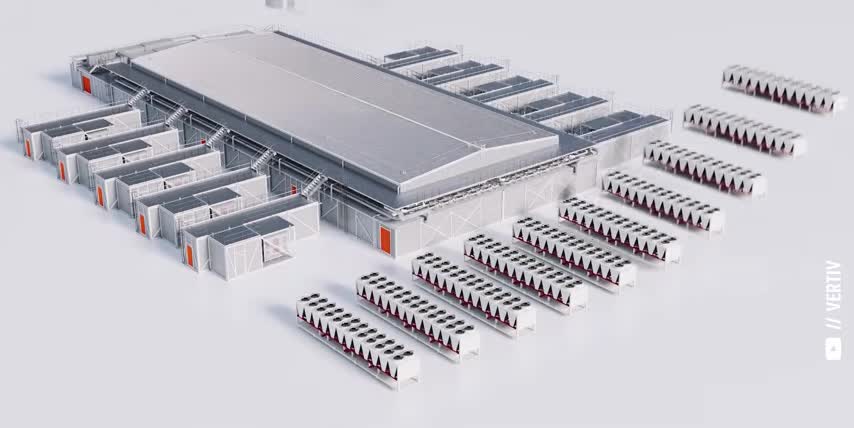
And that's the price they pay on the money that they borrow to build their infrastructure in the first place. Building AI data centers means paying for everything upfront. The GPUs, the racks, the cooling the power all that gets bought years before they start making revenue For example CoreWeave spent billion on capital expenditures last quarter even though they only made billion That not a bad thing. It's the entire business model. Build it and they will come. But that means they need to borrow money to build it in the first place. And that means we need to look at metrics like their net debt, which is just their total debt minus their cash on hand. Net debt is what they would still owe if they emptied their bank accounts tomorrow.
We also care about how much they pay in interest as a percentage of their total revenues. Corweave has about $35 billion worth of loans, another $16 billion in lease obligations for the data centers they don't own, and $5.5 billion in cash.
35 plus 16 minus 5 is roughly billion in net debt, but they paid 0 million in interest last quarter alone, which is about 25% of the revenues they brought in. That makes a huge difference to their bottom line. CoreWeave's operating losses for the quarter were million, but their net loss was 6 million; almost the entire difference is interest. That's why net debt and interest expenses are important numbers to compare across all three companies. Either way, the takeaway for investors is pretty simple: Nvidia is CoreWeave's core infrastructure supplier, their launch platform, and their buyer of last resort, which seriously strengthens CoreWeave's position in the neo‑cloud market.
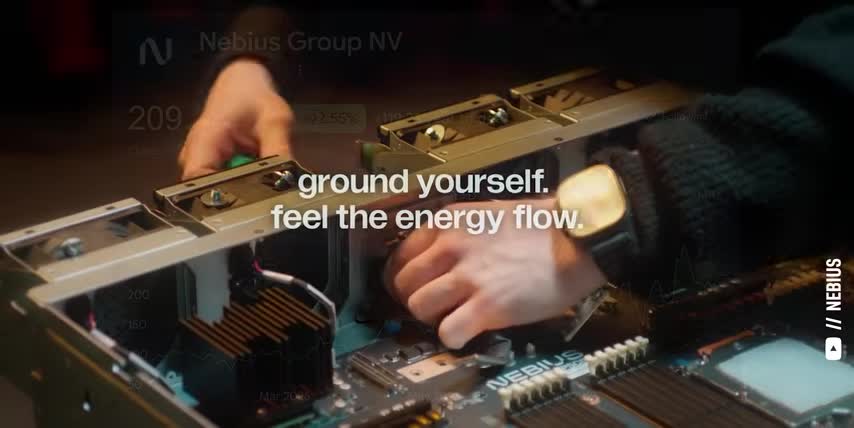
But what Nvidia can't do is lower CoreWeave's interest expenses.
NeoCloud Comparison & Verdict
All right, let's talk about Nebius, ticker symbol NBIS. Since they have the strongest balance sheet and the fastest growth in the group, Nebius is one of the most technically advanced neo‑clouds out there. They've already received their first Vera Rubin and VL72 systems, and Nvidia's CFO said that Nebius will be the first company anywhere to get the new Grok 3 LPX inference chips in volume. Nebius runs both kinds of AI workloads under one unified platform: Aether is their cloud where customers can rent GPUs and train their models, while Token Factory sits on top of it and handles inference.
Nebius's inference workloads more than tripled last quarter alone. And more and more of that is coming from Agentic AI, where a single task can trigger dozens of different tool and model calls. That means that revenue scales with how complex the task is, not just how many users sign up. And on the infrastructure side, Nebius just raised their contracted power target from 4 gigawatts to 5 by the end of 2026. Remember, that's contracted power, not active. They expect to have 800 megawatts to 1 gigawatt of active power by the end of the year. And they're selling every single watt. Nebius has .5 billion worth of contracted work on their books, including a .4 billion deal with Microsoft and a contract with Meta worth up to billion.
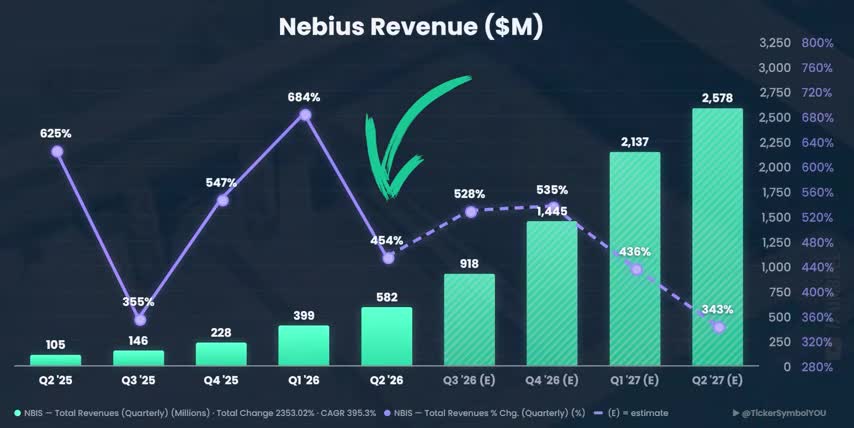
The special thing about Nebius is that they get paid before they build. Roughly 70% of the deals they closed last quarter came with customer prepayments that cover 50-60% of the equipment costs and they expect over $9 billion in prepayments this year. So customers are funding their AI buildout instead of high-interest loans. Last quarter, Nebius generated $582 million in revenue, which is up a whopping 454% year-over-year. And they're guiding for a $7 to $9 billion annualized run rate by the end of 2026, which would be close to a 7x from last year. Nebius has $8.5 billion worth of debt, around $1.5 billion in lease obligations, and $8 billion in cash.
That works out to about $2 billion dollars in net debt compared to Core, leaves $46 billion Nebius, paid $119 million dollars in interest last quarter or about 20 % of their revenue, but these two companies are operating on very different scales. Nebius is doing under $600 million dollars a quarter but promising 5 gigawatts of contracted power; as a result they'll be spending $20‑25 billion dollars to get there this year, and part of that funding is selling stocks, so Nebius might be saving on interest but their shareholders will pay in terms of dilution.
That leaves us with IREN (ticker symbol IREN), the former Bitcoin miner becoming an AI cloud. Last quarter IREN's AI cloud revenue hit .5 million and passed their revenues from Bitcoin mining for the first time. That AI number is up from .6 million just one quarter ago, meaning it more than doubled in the last 90 days. What separates IREN from the other neoclouds is they already did the hard part: they spent years buying land and power contracts to mine Bitcoin, which means they already have a pipeline of more than 5 gigawatts lined up for their AI data centers, and that's already won them two enormous contracts—a 5‑year .7 billion deal with Microsoft and a separate .4 billion deal with Nvidia.
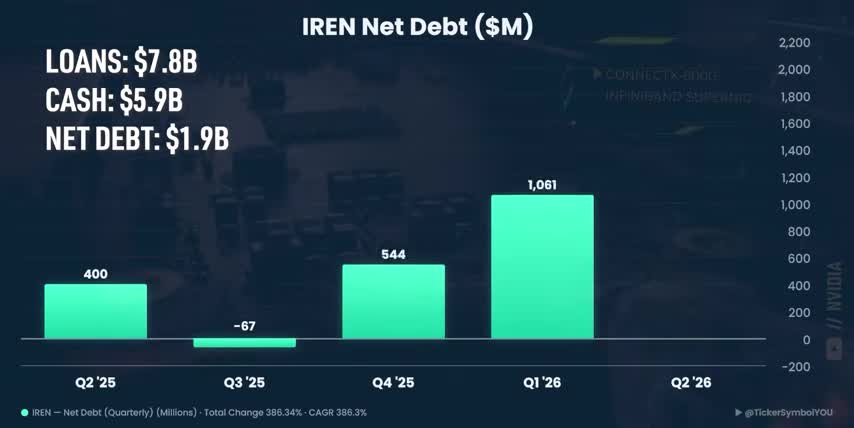
IREN currently has about .5 billion of debt and 0 million in cash, so about billion of net debt. They paid million in interest last quarter, or about 18% of their revenues. They also have a billion backlog and are targeting a billion annualized run rate from this year's capacity, about billion of that already online today, which means they expect to quadruple it in the next four months. Although management pointed out that the revenue they'll actually recognize could come in lower than that. As usual, IREN posted a huge loss of 4 million last quarter, most of which was a non‑cash impairment for writing off more of their Bitcoin hardware as they convert their sites to AI. That's the ongoing cost of pivoting from mining to training and inference, and their total revenue actually shrank from 5 million down to 7 million for the same reason—it’s faster to take Bitcoin servers down than it is to stand AI servers up.
Alright, before we can decide which of these stocks is the best buy right now, let's compare them apples to apples. If you feel I've earned it, consider hitting the like button and subscribing to the channel; that really helps me out and tells me to make more content like this, thanks. Now let's compare CoreWeave, Nebius, and IREN stock. Here's a table summarizing everything I've covered; keep in mind that I built it myself by pulling numbers from each company's latest earnings and tried to make every row as fair as I could, but all three companies have different fiscal calendars, different contract lengths, and they're scaling from very different starting points from the beginning of the year. So take this table as a good way to compare these companies but not as official audited numbers.
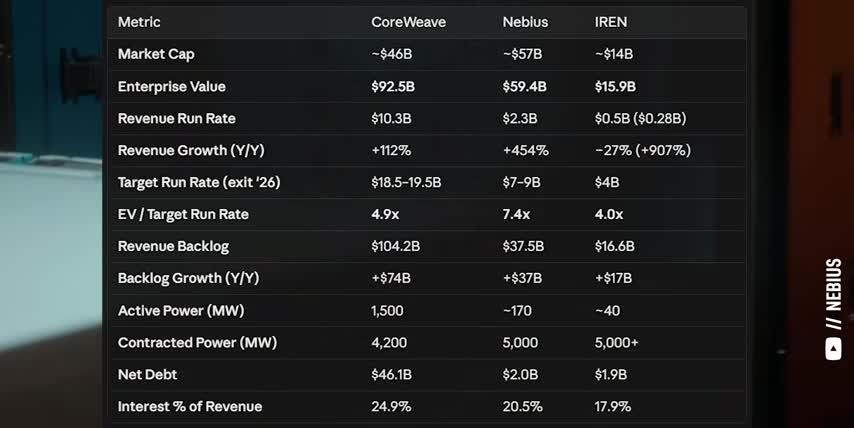
All right, here's what jumps out at me first: CoreWeave has a lot more net debt than the other two companies, so we want to compare them in terms of enterprise value instead of market cap. When you buy a business you buy its assets and its debts minus whatever cash they're holding, so enterprise value is a much better way to price debt‑heavy companies. Since CoreWeave's debt is as big as its market cap, its enterprise value ends up being twice as big. That said, CoreWeave is the clear leader in terms of scale—they're the biggest enterprise with the most revenue, the deepest backlog, and 1.5 GW of active power actually running today, but a quarter of every dollar they make goes right back to interest on their loans. Nebius is the opposite: 454% revenue growth with only billion of net debt and customers pre‑funding half of their entire build‑out. What surprised me is that Nebius has a higher market cap than CoreWeave with half the target revenue run rate and one‑third of the backlog.
That means Nebius' enterprise value is 7.4 times their year end run rate, against 4.9 for CoreWeave and 4 for IREN. IREN is the smallest and cheapest company at a $16 billion enterprise value, but they also have the lowest revenue run rate, $500 million total and $280 million if you only include AI and not Bitcoin. That's partially why have the largest AI revenue growth of more than 10x but from a much smaller base. Which one is actually the better buy also depends on whether you care more about active power or contracted power. If you go by active power, Coreweave costs around $62 million per megawatt while Nebius and Iren are over $350 million each. So Coreweave is the cheapest by a factor of 6.
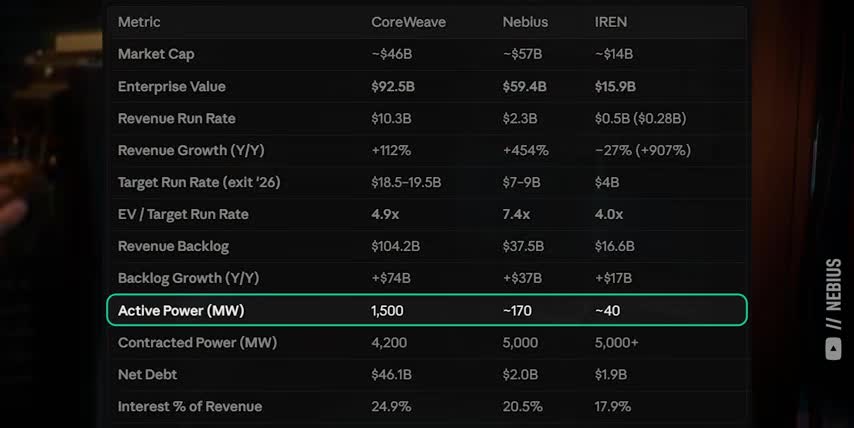
But if you go by total contracted power, IREN costs around million per megawatt, Nebius costs million, and CoreWeave costs million. That makes IREN seven times cheaper than CoreWeave by contracted power. So if you're the kind of investor that wants exposure to this category of stocks with the lowest execution risk, CoreWeave is probably the stock for you. They're the biggest company by far, with the most active power being used for AI right now, and they have Nvidia committed to buying any capacity they can't sell through April 2032. If I was a newer investor or closer to retirement, CoreWeave is the one I'd pick.
But if you're looking for the most upside, IREN is the smallest company with the most contracted power per dollar, the lowest interest payments relative to their revenues, and they're the cheapest based on their size and their target revenue run rate. The biggest risk for IREN is whether they can actually turn their contracted power into real revenues or if their pivot from Bitcoin mining will cost them too much too soon; I think this risk is already priced in, so IREN is the one I'd go with if I could only pick one of these companies. If you’re not sure, Nebius sits right in the middle of them on almost every single metric, so they might be the right stock for you as long as you're all right with them being much more expensive. Let me know which stock you're buying in the comments, or if you want me to make a deep‑dive post on any one of them. And if you want to see what other stocks I'm buying to get rich without getting lucky, check out this post next. Either way, thanks for reading, and until next time, this is TickerSymbol: YOU—my name is Alex, reminding you that the best investment you can make is in you.

Checkout our YouTube Channel
Get the latest videos and industry deep dives as we check out the science behind the stocks.