Table of Contents
1. Why AI and Agents Caused Both Stocks to Skyrocket
2. Memory: A Much Bigger Business
3. AMD's Latest Earnings and Risks
4. Which AI Chip Stock Is the Better Buy Today
Key Takeaways
- AI agents are driving demand for CPUs and memory, not just GPUs, changing the dynamics of AI data centers.
- Micron's data center revenue ($34B) is nearly 3x AMD's and Intel's combined, yet Micron trades at under 7x forward earnings vs AMD's 45x.
- AMD faces up to 16% dilution from OpenAI and Meta warrants, while Micron has locked in a third of revenue through 2030 with $32B in customer commitments.
- Memory cycles are notoriously volatile—Micron's low P/E reflects market skepticism, but HBM demand and long-term contracts make this cycle potentially different.
- The author favors Micron at current prices due to valuation and contract visibility, but would only buy AMD after a pullback.
If you put $10,000 into AMD stock just one year ago, you'd have over $35,000 today. But if you invested that in Micron instead, you'd have almost $60,000 right now. Both stocks skyrocketed because both companies make chips that every AI data center can't get enough of. But Micron made investors a lot more money. A 10-bagger in just two years. My name is Alex, and I spent eight years as an electrical engineer and AI researcher at MIT. which helped me find great stocks like Nvidia, TSMC, and Micron years before the rest of the market. So let me show you why I picked Micron over AMD for these last few years, and what I think about both stocks today. Your time is valuable, so let's get right into it. First things first, I'm not here to waste your time, so here's what I'll talk about up front.
Why AI and agents caused both stocks to skyrocket, what made me pick Micron over AMD years ago, and stick with it through today. I'll compare AMD and Micron's latest earnings, to see if my logic still holds up, and of course which of these two stocks I'd buy today as a result. There's a lot of ground to cover, so let's start with what made these stocks skyrocket in the first place. For the first few years of the AI boom, most of the money went to one kind of chip, the GPU. When you ask a chatbot a question, a GPU runs it through an AI model, which generates an answer while the CPU manages workloads to keep the GPUs fully utilized. That's why there were four or even eight GPUs for every CPU in an AI data center. But AI agents don't work the same way.
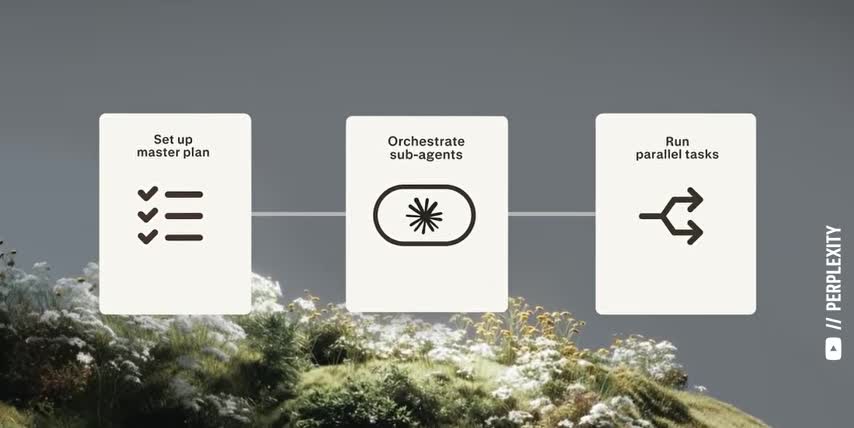
You don't give an agent a prompt or even a single task. You give it a goal and then the agent breaks that goal into steps, decides what to do at each step, like what to research, what tools to call, what code to write, and even what other AI models to ask, and how to check its answers, and then it loops through each of those steps until its goal is met. And, while thinking and planning happens on the GPU, most of the tool calls, the code running, and the database lookups happen on the CPU. As a result, the ratio of GPUs to CPUs in AI data centers is shrinking from 8 to 4 to 2, and AMD says that in some cases, we could even see more CPUs than GPUs altogether. And just like with GPUs, CPU makers just can't make them fast enough.
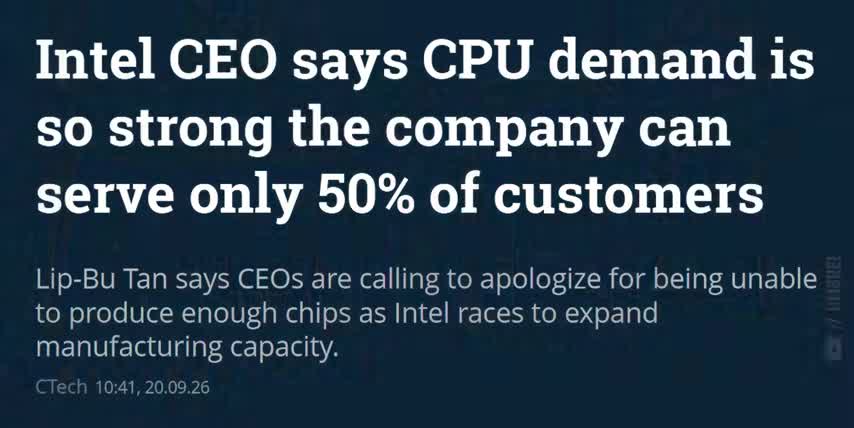
AMD's CEO Lisa Su said that the server CPU supply chain has been tight since the start of the year, because so much of this demand wasn't forecasted in advance. And Intel's CEO said that CPU demand is so high that Intel can only serve about half of its customers. One week after he said that, AMD's stock popped almost 10% in a single day and hit a trillion dollar market cap for the first time in the company's history. But as bad as the CPU shortage is, the memory shortage is even worse. Micron expects memory to stay tight beyond 2027, and Samsung says the shortage will last through 2028, with no signs of supply catching up to demand. end. Micron also has the same problem as Intel, saying they can only meet about half to two-thirds of the demand from their major customers.
Micron's DRAM prices jumped by more than 60% this past spring. And Intel's CEO said that some memory prices actually went up more like 5 to 7x. Memory is also a lot more universal. AMD's server CPU market share has been steadily climbing since well before the AI era, and they have a massive 46% share of the x86 server market by revenue today. But AMD doesn't just have to win against Intel's x86 chips, they also compete against ARM-based chips, including ARM's own new AGI CPU, and against Nvidia's custom Vera chips. On top of that, each point of market share is harder to gain than the last, since at At some point, they'd be trying to sell to customers that are built completely around their competitors or around their own custom chips.
On the flip side memory makers get paid no matter who wins the GPU or CPU markets because every processor needs DRAM That what made me start buying Micron years ago and keep buying it ever since NVIDIA VARA Rubin racks have 36 superchips in them and each one has a VARA CPU linked to two Rubin GPUs. Each of those GPUs has 288GB of high-bandwidth memory sitting right next to it, and each CPU has up to 1.5TB of lower-powered DRAM. So, if you add up all the memory inside one of these racks, the GPUs have almost 21 terabytes of memory, and the CPUs have up to another 54, almost twice as much memory. So, as AI agents take off, data centers will need more CPUs, but they'll also need far more memory.
According to MarketUS, the global artificial intelligence market is expected to almost 19x in size over the next 9 years, which is a compound annual growth rate of 38.5% through 2034. But many of the companies building next-generation AI applications are not publicly traded. Think about the 90s and early 2000s. Companies like Amazon and Google went public very early in their growth cycle, but today, they're waiting an average of 10 years or longer to go public. That means investors like us can miss out on most of the returns from the next Amazon, the next Google, the next Nvidia. That's where VCX comes in, the sponsor of this video. VCX is the public ticker for private tech.

Venture capital is usually only for the ultra-wealthy, but VCX by Fundrise gives everyday investors access to some of the top private pre-IPO companies on earth.
They have an impressive track record, already investing over $500 million dollars into some of the largest most in demand ai infrastructure and space launch companies so if you want access to some of the best late stage companies before the ipo check out vcx by fundrise with my link below today all right ai agents need more memory even beyond the cpu as a model works through the task it keeps a running record of everything so far called the kv cache and it does that so it doesn't have to reprocess everything for each new word the longer a session runs the bigger this kv cache gets once it fills the gpu's high bandwidth memory it spills into regular dram and then to the solid state drives
memory is a much bigger business last quarter micron's data center segment brought in 34 billion dollars that's almost three times more than AMD's and Intel's data center revenues combined.
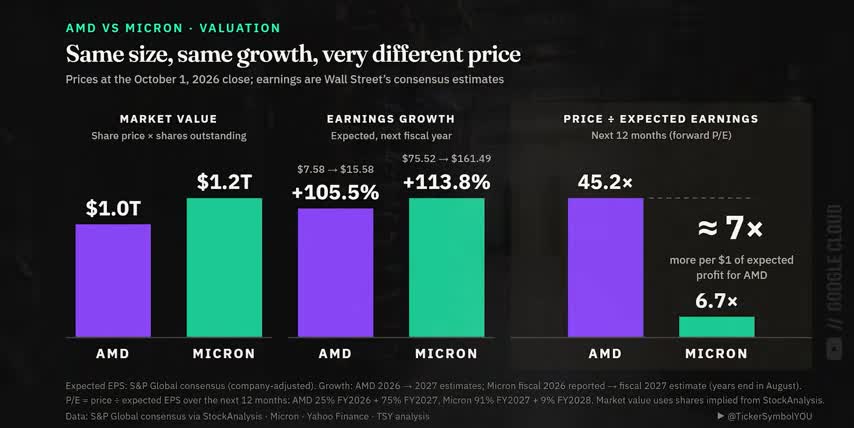
And that's counting all of AMD's GPUs as well. And don't forget that Micron isn't even the biggest memory maker. Samsung brought in significantly more. Both AMD and Micron are worth around a trillion dollars today. And Wall Street expects both companies to roughly double their earnings next year. But here's the catch.

Investors are paying over 45 times next year's expected earnings for AMD but they're paying less than seven times for Micron, said another way AMD is roughly seven times more expensive than Micron per dollar of expected profit. Like I've been saying for years now, that doesn't make AMD a bad company—that's never been the question. The real question is whether AMD is a good investment. On their latest earnings call AMD reported record revenues of $11.5 billion, which was up 50 % year over year. Their data‑center business more than doubled, driven by the continued ramp of their Instinct GPUs and their EPYC server CPU sales, which went up by more than 70 %. AMD is guiding for about $13 billion of revenue next quarter, and Lisa Su expects server revenue to grow more than 80 % in the second half of this year and more than 70 % on top of that in 2027, but AMD does have a big risk that investors need to know about.
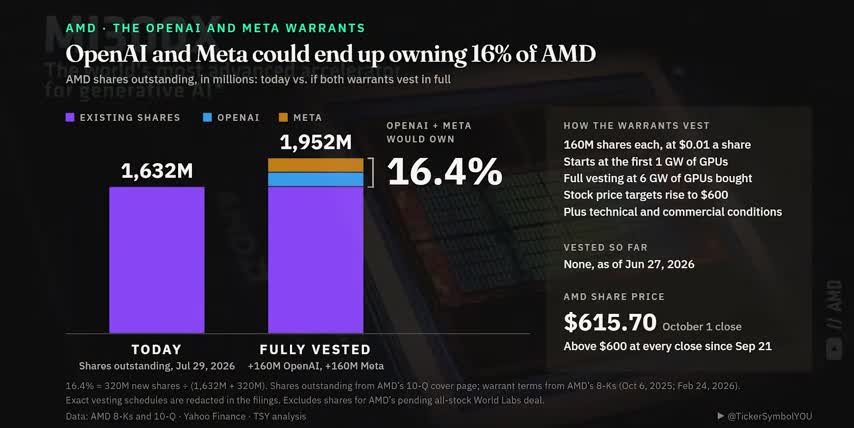
Two of their biggest deals also give OpenAI and Meta Platforms warrants the right to buy up to 160 million shares of AMD each at one cent apiece, which means that OpenAI and Meta will own up to 16 % of AMD combined after accounting for dilution. As more GPUs get bought and delivered, the final price milestone for these deals is AMD stock hitting $600 per share, and it is already above that price. So if these deals play out in full, AMD shareholders will get diluted by around 16 %, which is a pretty big downside. Micron's earnings call was just a few days ago and they reported $54.2 billion in revenue.
That's about 8% above their own forecast and almost five times what they made a year ago. So not only is Micron bringing in four times more revenue than AMD, but they're also doing it at much higher margins. AMD reported 56% gross margins. Micron reported 87%. Micron expects next quarter's revenues to come in at $61.5 billion.
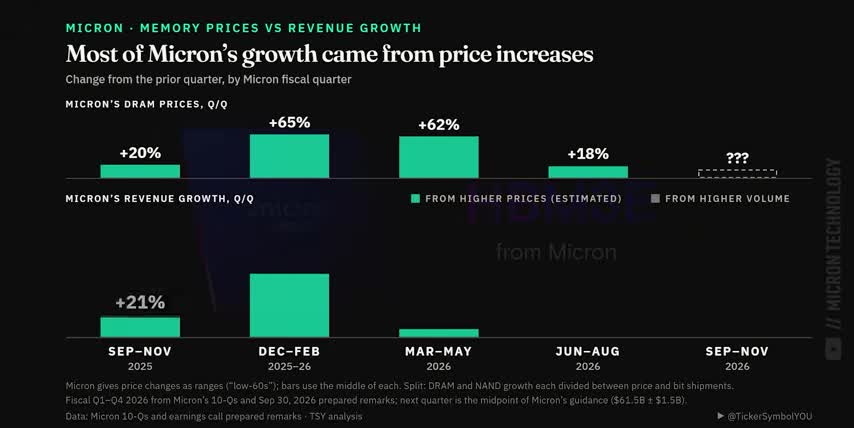
dollars that's roughly the same 13 jump in revenues that amd expects but from a baseline that's more than four times bigger micron also has a big chunk of their revenues locked into contracts they signed 26 long-term deals that cover more than a third of their total revenues through 2030 that are already backed by 32 billion dollars in customer commitments and most of their high bandwidth memory is already sold out through 2027 at much higher prices than this year but micron also has some risks that investors should keep in mind first memory prices are still on the rise but they're rising much slower than before microns d ram prices jumped more than 60 percent this past spring less than 20 over the summer and micron expects a slower rate of price increases going forward a lot of micron's growth came from these price increases so its own growth is already slowing down quarter over quarter their revenues grew by 74 percent two quarters ago 31 last quarter and they're expecting 13 sequential growth next quarter
the second risk is that micron is spending a lot more on new factories to meet future demand they spent 27 billion dollars on fabs and equipment last fiscal year and they plan to spend about 25 billion dollars more in the next six months alone so between slowing price increases for memory and all of their new spending on production micron's margins should start to fall over time
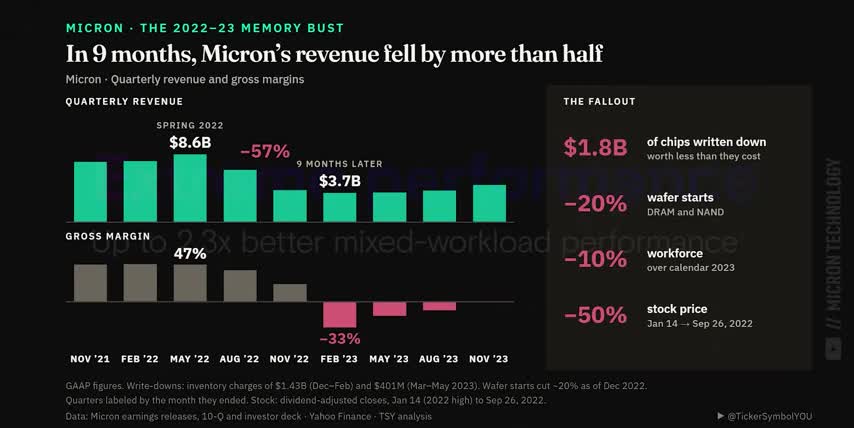
I think this is a big part of why Micron trades at a much lower multiple than AMD. Memory has one of the most brutal boom and bust cycles in tech. As a long-time Micron shareholder, I've lived through a few of them, and the last one was just a few years ago. In spring of 2022, Micron brought in $8.6 billion. dollars. Nine months later, they were down to 3.7 billion, and their gross margins tanked to negative 33%. Micron had to write down almost 2 billion dollars of chips because they were worth less than the cost to make them. And they had to cut their wafer production by around 20%, their workforce by 10%, and their stock got cut in half. The big risk for investors is that memory stocks look cheapest right at their peak.
That's because earnings get so high that the market cap looks tiny in comparison. In January of 2018, Micron traded at just 4.5 times forward earnings. Over the next year, the stock fell by 27%. In June of 2022, it traded at around 6.5 times forward earnings. But by September, it was down by another 35%. Micron stock is currently trading at under seven times forward earnings yet again the stock price also tends to peak before the earnings do in 2022 micron stock topped out in january while their revenue kept setting records until june so when memory prices start to slow down like they're doing right now a lot of investors don't stick around to find out how the cycle will end the biggest difference today is high bandwidth memory hbm uses about three times as much silicon as regular d-ram and that ratio keeps climbing with every new generation.
That means each new generation of HBM chips eats more and more supply that could have gone to regular memory, which is a big factor in the overall memory shortage. Micron's long term contracts also come with price fours, and Micron said that they expect their margins to be meaningfully above the peak margins of any previous cycle even at those four prices But these contracts only cover about a third of Micron revenue. The rest still depends on the market. And there's a lot more memory supply that's about to hit the market.
Micron's new fabs in Idaho and Japan start production between mid-2027 and late 2028 and samsung and sk hynix are ramping up production too samsung specifically has been catching up fast when it comes to high bandwidth memory their market share jumped from 21 to 33 in a single quarter while microns fell from 21 down to 18.
microns low forward p-e ratio is really the market betting that this cycle ends the same way they all do all right so let's answer the big question which of these two high growth ai chip stocks is the better buy today and if you feel i've earned it consider hitting the like button and subscribing to the channel that really helps and it lets me know to make more comparison videos like this thanks now let's decide between amd and micron stock the best way to compare them is to see what's already baked into the stock price nvidia and broadcom trade at about 17 to 18 times forward earnings so if amd traded at that same ratio the stock price would be under 250 dollars per share but let's look at it the other way around instead for amd to be worth its price at that multiple they would need to earn about 35 per share next year wall street expects about 15.60 in earnings so amd would need to more than double its earnings again from here and that's before any dilution from the open ai and meta deals that i mentioned earlier so amd's stock price already has many years of fast growth baked right into it and they have to keep winning share of the cpu and gpu markets to justify it which gets increasingly more difficult
micron stock is in the opposite situation if micron traded at 17 or 18 times earnings the stock price would be at over 2700 dollars per share so today's price only makes sense if Micron's long-term earnings fell by about 60% from what Wall Street expects next year and stayed there over the long term.
But analysts actually expect Micron's earnings to keep rising into 2028. Micron also generated $33 billion in free cash flow last quarter alone. They have $68 billion more in cash than they have debt and they plan on ramping up their share buybacks and eventually handing all excess cash back to their shareholders. So by today's numbers, Micron stock is much better value, but it could also be the much bumpier ride. If memory prices keep slowing down, the stock could drop hard while their earnings are still growing, just like it did in 2018 and 2022. AMD is a great stock to own for the long run, and the business is firing on all cylinders. They sell CPUs and GPUs, so they also have a longer runway.
But at more than 45 times forward earnings and up to 16% dilution on the horizon, I think it's already priced basically to perfection. So I would only buy AMD stock after a big pullback. Micron's price already assumes that a big drop in earnings is coming. Even though a third of their revenue is already under contract, high bandwidth memory makes this cycle meaningfully different from the last two, and they're about to ramp up how much money they return to shareholders via buybacks. That's why my plan for now is to keep buying Micron stock, even though it's already 10x'd from when I started. If DRAM contract prices start to go flat or even start to fall while they keep spending more money on new fabs, that's my signal to stop buying the stock.
For AMD, I'm either waiting for the dilution to hit and the stock to drop or for them to crush earnings to the point where their sky-high multiple looks a lot more reasonable. And if either of those happen, I'll be sure to make a video and let you know. So, let me know in the comments if you're buying AMD, Micron, or another stock altogether. And either way, thanks for watching, and until next time, this is Ticker Symbol You. My name is Alex, reminding you that the best investment you can make is in you.
Checkout our YouTube Channel
Get the latest videos and industry deep dives as we check out the science behind the stocks.