The key to finding great stocks before everyone else is understanding a company's products, not just their profits. Huge growth happens when a company has the perfect product for a hot new market. Nvidia 10x'd in size because their chips dominate AI data centers. Palantir printed millionaires because their platforms bring AI to highly regulated industries. Well, there's another AI market that's quietly changing which stocks will win big, and almost no one else is covering it. My name is Alex and I spent 8 years as an electrical engineer and AI researcher at MIT and I've never seen a market opportunity this big. Let me show you what's going on and how I'm investing in it. Your time is valuable, so let's get right into it. I want to start this post in an interesting place.
November 2022 in San Francisco. OpenAI has just released ChatGPT and it instantly spread like wildfire, hitting 100 million users in just two months. ChatGPT grew four times faster than TikTok, 15 times faster than Instagram, and 25 times faster than YouTube. The wave that followed turned out to be the biggest technology investment cycle since the internet. In under four years, NVIDIA would grow from a $400 billion valuation to over $5 trillion because they designed the chips that power ChatGPT and every generative AI application that came after it. Investors who caught it early made life-changing returns, and they caught it early by understanding the science behind the stocks. But we're still in the very early innings.
AI Market Growth

the average worker had three or four work machines in 2023 a laptop a desktop a server login and maybe a separate work phone that number exploded when software started needing logins of its own service accounts ip keys and certificates ai agents are the newest and fastest growing part of that, and 99% of organizations say they're already using them. But an AI agent isn't a normal piece of software. You don't tell it what to do. You give it an end goal, and it decides how to get there by building a step-by-step plan, reading files and data, calling tools and writing code, and even creating sub-agents to handle different steps along the way. And to do that, it needs credentials, usernames, passwords, API tokens, system permissions, and so on.
AI Agents in the Workforce
But normal software security systems aren't built to handle that. For example, two-factor authentication sends a code to your phone. But AI agents have no phone to go to. Normal permission systems are designed for human users, not software. So AI agents just inherit whatever permissions the software they're running on already has. And normal offboarding isn't meant for software either. Nobody files paperwork to retire an AI agent or verify that it lost its access after finishing its task. Over 1.7 trillion dollars were spent on AI in 2025, but only 2.8 billion were spent securing it. Said another way, for every 630 dollars spent on AI, only one is spent protecting it. That's the biggest gap I've anywhere in the AI market. And big gaps mean big opportunities.
Security Gaps

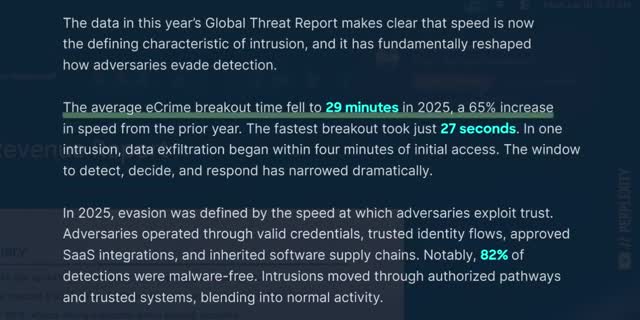
Now let me tell you something that'll put you ahead of almost every Wall Street analyst covering AI agents. This gap is hyper specific to identity management. According to CrowdStrike, 82% of threat detections last year were malware free. There was no virus to find because hackers are logging in with valid credentials and using the company's own admin tools. Attack speeds are also exploding. The time it takes for an attacker to get in and reach a second system went from 48 minutes in 2024 to 29 minutes in 2025—a 40% improvement in a single year—with the fastest break time coming in at just 27 seconds. That's shorter than a red light. That's because attackers are using AI too. AI-enabled break-in attempts rose 89% year over year.
Identity Management Opportunity
That's attacks like injecting malicious prompts into companies' AI tools like Claude and Copilot to generate commands and steal credentials. Here's the big takeaway for investors. It's getting harder and harder to tell the difference between a legitimate user and an attacker. Detections triggered by legitimate AI agents are growing 150% faster than human-triggered ones. That means real attacks are hiding inside a flood of approved machine activity. That's why I'm not buying stocks that are focused on protecting against viruses or malware. I'm buying the ones that are focused on protecting identities.
And like I said earlier, according to MarketUS, the global artificial intelligence market is expected to almost 19x in size over the next nine years, which is a compound annual growth rate of 38.5% through 2034. But many of the companies building next-generation AI applications are not publicly traded.
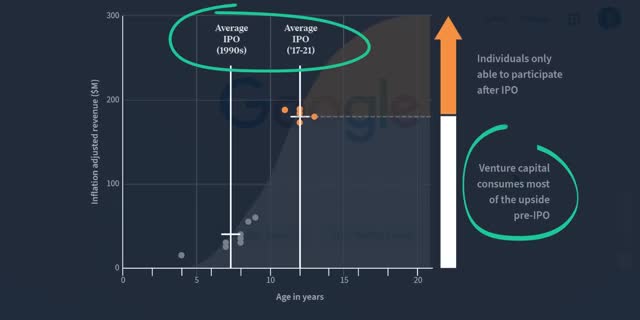
Think about the 90s and early 2000s, when companies like Amazon and Google went public very early in their growth cycles. Today, they wait an average of ten years or longer to list, meaning investors like us can miss out on most of the returns from the next Amazon, the next Google, the next Nvidia. That’s where VCX comes in.
If you want access to the best late‑stage companies before they IPO, check out VCX by Fundrise. Today, for every $630 spent on AI last year, only one dollar went to securing it—a massive market opportunity, especially in distinguishing a legitimate AI agent from an attacker using stolen credentials. There are three companies I think are perfectly positioned to tackle this opportunity; let’s start with Palo Alto Networks, ticker symbol P‑A‑N‑W.
If you've been watching this channel for a while, you know that I invest in technology platforms that other businesses pay to build on top of. While most of the cybersecurity landscape is fragmented into hundreds of different kinds of vendors, services, and solutions, Palo Alto Networks focuses on consolidating, as many as possible, into integrated platforms so that their customers can deal with one vendor, one management console, and one bill. In the enterprise world, that's a huge deal. Palo Alto has three main platforms that work together across the entire AI security stack. Strata, Prisma, and Cortex. Strata is their foundational layer for AI infrastructure deployment.
It includes next-generation firewalls that use machine learning for packet inspection, application-based traffic routing, threat detection, and response. Companies are using it to see their network analytics, forecast outages, and even automate actions based on specific security policies. Strata becomes a key piece of the puzzle as more companies upgrade their networks to support AI workloads and agents. Prisma handles cybersecurity for cloud environments, services like container security, workload protection, and scanning AI models for vulnerabilities and blocking prompt injection attacks.
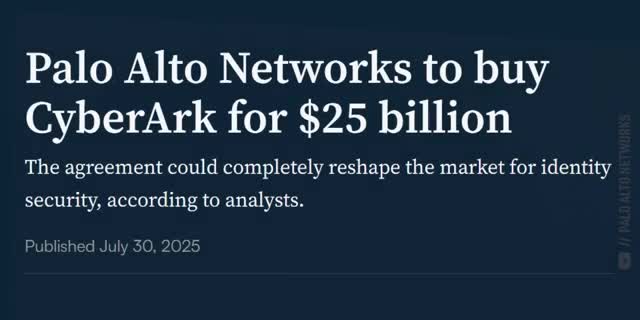
And Palo Alto's Cortex platform focuses on SecOps, the teams that respond when something actually goes wrong, by providing tools for extended threat detection and response, automation, and advanced analytics to help cybersecurity teams do up to four times less manual work and respond to threats up to 50 times faster. Remember what I said earlier, attack speeds got 40% faster last year alone, and the fastest break-in took just 27 seconds, making Cortex another important piece of the AI security puzzle But the biggest piece just got added last quarter when Palo Alto Networks closed its acquisition of CyberArk for billion CyberArk is a leader in identity security not just for people, but for machines and AI agents, which is why I covered them as Agentic AI was taking off last year.

Well, back in May, Palo Alto Networks launched a fourth platform called Adira, a single place to manage identities, access, and permissions for every human, every machine, and every AI agent. Palo Alto Networks reported $3 billion in revenue last quarter, which was up 31% year over year. But annual recurring revenue from next generation security hit $8.1 billion, which is actually up 60% from last year, though $1.6 billion of that came from acquisitions, so their organic growth was closer to 28%.
They report their full-year earnings on September 1st, and this will be the first quarter with Adira on the market, so I'm excited to see their facts and figures around identity management. Either way, I think this integrated end‑to‑end four‑platform approach puts Palo Alto Networks in a great position to grow as enterprises shift more money into securing their AI infrastructure, their AI software, and their AI agents.
On the other end of the cyber‑security stack is Cloudflare (ticker symbol NET). Cloudflare runs one of the largest networks on the planet. When you load a web page protected by their services, your request hits their network before it ever touches the website itself; they absorb the attacks, block the bots, serve up cached content, and encrypt the traffic before letting it through. A huge share of the world’s websites sit behind Cloudflare, which means they see network‑traffic patterns that no one else can see. That digital force field is their main product, and they sell access to it in three different ways.
First, application services. They cache content close to the user, so pages load faster. They absorb denial-of-service attacks, filter out malicious requests, and handle the bots. This is the layer that decides what traffic reaches a company's website in the first place. Second is Cloudflare 1, their zero-trust platform. Zero-trust just means that the network doesn't trust anything by default. It checks every ID at every gate, every time. That means Cloudflare's whole model runs on validating identities and permissions for people and for AI agents. And third is their developer platform called Workers. Companies can run their code on Cloudflare's network instead of in their own data centers, so that it executes close to whoever is actually calling it.
Close to 2 million developers joined their platform last quarter alone, and a lot of that growth is coming from people building AI agents cloudflare hosts the agents sees what web traffic they generate and controls what they're allowed to reach but here's where things get interesting according to cloudflare ceo matthew prince bots have already passed humans in terms of total web traffic about 57 of all page requests are now automated with the other 43 coming from real people and on their earnings call just a few days ago, Cloudflare said that daily requests from AI agents were up by more than 1,700% year over year. Cloudflare reported $696 million in revenue last quarter, which is up 36% year over year, and they raised their guidance to $2.87 billion for the year.

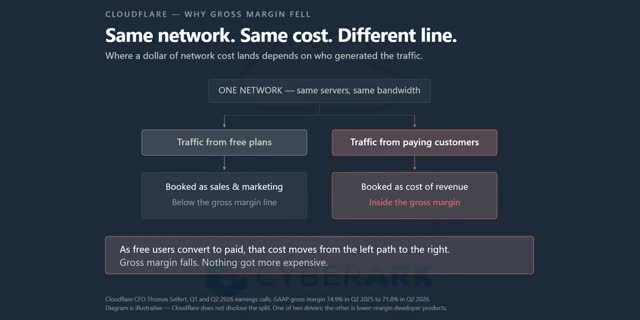
Gross margins came in at 71.8%, which is actually down from 74.9%. I looked into why and I found two main reasons, both of which are actually good. How can lower gross margins be good, you ask? Well, let me show you. The first reason is that paid traffic grew relative to free traffic. Paid traffic is capacity that's consumed by Cloudflare's paying customers, and servicing it comes out of costs of revenue, since it's the cost of delivering a service that customers are paying for. That lowers their gross margins. Free traffic is capacity that's consumed by customers on free plans.
Cloudflare books that under sales and marketing since the free tier is how they get people onto their network in the first place, and sales and marketing is an operating expense, so it comes out after gross margins So as more customers shift from free plans to paid plans Cloudflare margins naturally The second reason is the science behind this stock Servicing AI agents simply is more expensive than servicing traditional websites Worker execution inference costs, controlling agents and AI web crawlers all consume new resources, which is why cost of revenues grew by 53% year over year, against their 36% revenue growth. Every company that's switching from serving people to serving people and AI agents is going to see their costs go up the same way.

So Cloudflare is just the canary in the coal mine. Either way, I think that Cloudflare's position as the barrier between users and websites put them in a unique position to scale as more web traffic and more cyber threats come online from AI agents. That brings me to SailPoint, ticker symbol SAIL, the smallest company on this list by far. And if you feel I've earned it, consider hitting the like button and subscribing to the channel. That really helps the channel and it lets me know to make more content like this. Thanks. Now let's talk about SailPoint.. Identity management is a boring job that every company has to do. When somebody joins, they need access to email, file servers, timesheets, and whatever software they need to do their job. they change rules, so does their access.
And when they leave, all of it needs to get shut down. And once a year, somebody has to prove to a security auditor that everyone's access still makes sense. SailPoint sells the software to manage that entire lifecycle. Remember, one of the big problems with AI agents is that nobody files paperwork to retire them. Well, back in May, SailPoint extended their software to do just that, with a service called agentic fabric. It inventories every AI agent, machine identity, and application inside a company and then maps each one to a human owner. That's important because it turns out that only 37% of organizations can revoke an AI agent's credentials today, and you can't revoke something if nobody owns it. SailPoint even tells you what percentage of identities they manage aren't human.
On their June earnings call, their CEO said that non-human identities were responsible for 40% of their growth that quarter, and now make up 14% of everything they manage on their cloud platform. Said another way, 1 in 7 accounts they manage are now machines, and so are 4 out of every 10 new ones. And that number will only keep growing as the ratio of AI agents to humans keeps going up. As of their latest earnings call, annual recurring revenue hit $1.16 billion, dollars which was up 26 year over year with the cloud portion of that growing by 36 percent revenues for the quarter came in at 280 million dollars and those were up 22 and all of these numbers beat the top end of their guidance salepoint is one of the last standalone vendors of any size doing this job on one hand that means they have to compete with companies that can bundle that service with a lot of other things that customers already pay for like palo alto networks and their platforms, but on the other hand, it makes SailPoint a prime acquisition target.
Palo Alto paid almost 20 times ARR for CyberArk when the deal was announced, and almost 15 times ARR by the time the deal closed. At those same multiples, SailPoint would get acquired for around $20 billion, which is almost double its current market cap. Just to be clear, nobody is making an offer to buy SailPoint at the time of this recording. I'm just pointing out the math. SailPoint reports earnings again in a few weeks, and I'm curious to see how many machine identities they'll end up managing. Another canary in the coal mine for what's coming as more businesses adopt agentic AI. And we're still in the very early innings.

The global market for AI agents is expected to grow by almost 44% per year, with the number of machine identities per human growing from 45 in 2024 to over 100 in 2026 breaches and cyber attacks are too costly to ignore so every company on earth will need a way to manage these machine identities that's why i'm investing in these three stocks and if you want to see what other stocks i'm investing in check out this video next either way thanks for watching and until next time this is ticker symbol you my name is alex reminding you that the best investment you can make is in you Thank you.
Table of Contents
1. AI Market Growth
2. AI Agents in the Workforce
3. Security Gaps
4. Identity Management Opportunity
Key Takeaways
- AI market projected to exceed $10 trillion by 2034.
- Machine identities per human are rapidly increasing, creating security gaps.
- Identity‑focused security solutions are poised for massive growth.
- Companies like Palo Alto Networks, Cloudflare, and SailPoint are well‑positioned.
- Investors can access private‑tech opportunities through VCX.
Checkout our YouTube Channel
Get the latest videos and industry deep dives as we check out the science behind the stocks.