Table of Contents
1. Introduction to AI
2. AI Model Training
3. AI Model Fine-Tuning
4. AI Inference
5. Google AI Dominance
6. Google Earnings Report
7. Key Takeaways
What if I told you that the most powerful AI company on Earth isn't NVIDIA, or Tesla, or Palantir? And what if it just posted its best quarter of the entire AI era, and the stock dropped anyway? My name is Alex, and I spent 8 years as an electrical engineer and AI researcher at MIT. And I've never seen one company dominate so many high-growth markets at the same time. So let me show you what just happened, and how I'm investing in it. Your time is valuable, so let's get right into it. I want to start this video in an interesting place, your web browser. You type a question into the search bar, hit enter, and within a single second, you have your answer.
Not just a bunch of links or copy-pasted quotes, but three or four paragraphs of organized information, drawn from dozens of sources, and reassembled into something just for you. An answer that didn't exist anywhere on the internet until you asked for it. I find that pretty amazing. But what's even more amazing is what happens in that one second. The four layers of insane technology that your question had to go through and how much it all costs. The first layer is the AI model itself. As fancy and as complicated as everybody tries to make it sound, all AI models really do is predict the next step. Large language models predict the next word, video generation models predict the next frame, and so on. And all AI models have three stages to their life cycle.
Introduction to AI
The first stage is training, where you show a model a huge amount of data, every website on the internet, almost every digital book, all the publicly available code, and then you give it a brand new sentence and ask it to guess the next word. When it guesses wrong, you have it try again. The more training data you give the model, the more chips you let it use to train, and the longer you let it train on those chips, the better its predictions become. Then, once you're happy with the model's overall performance, you lock in the parameters. – billions of numbers that describe everything the model learned along the way. When somebody says a model has 400 billion parameters, they're referring to these numbers. Training on more data takes longer, so it costs more money.

AI Model Training
Using more chips means more electricity, which costs more money. And giving the model more parameters also costs more money. Model makers like OpenAI and Anthropic focus on this stage, which is why they end up burning so much money. Stage 2 is fine-tuning. Most people forget about this step, but it's the one where a lot of the magic happens. A freshly trained model has no idea what a helpful answer looks like, so you have to give it feedback over time. Thumbs up and thumbs down, follow up prompts with more context and instructions, custom guard rails, all until the model learns to give the right answer in the right format for that specific use case.
This is also where models learn to break complex prompts into steps, use chain of thought reasoning to solve each step, put everything back together correctly, and return one coherent answer. Fine-tuning is also where smaller, faster, and cheaper models even come from. Once you have a huge, high-performing AI model that you spent millions of dollars to train, you can make it teach much smaller models. The main model works out millions of answers, and the smaller model copies its homework, not just the answer, but also how it got there. That's called distillation, and it's how all these AI labs have so many different models for different kinds of tasks.
AI Model Fine-Tuning
Fine-tuning costs a fraction of what it costs to train a model, which is why most companies can afford to at least try this step themselves. When you hear about a business building its own AI on top of an open-source model like Llama or DeepSeq or Kimi K3, this is what they're doing. So training happens once and fine-tuning happens every few months to keep the model up to date for its specific uses. But this final stage happens every time you hit enter. Stage 3 is called inference. This is the step where everything comes together, and it happens in that single second between you hitting enter and reading your answer. The model reads your brand new and, let's be honest, probably poorly written question, and has to create a step-by-step plan to tackle it.
AI Inference
It has to execute that plan, organize its answer, and return it all to you. It decides how much to think and reason about each step, what tools to call and what code to write along the way, what information to go look up and read, what other models it can talk to, and it can even spin up little copies of itself which are called sub to do all these things in parallel Here the most important thing that investors need to understand For stages 1 and 2 training and fine the company decides how much to spend how much data to train on, how many parameters to use, how many chips to use, and for how long. But customers decide the cost of inference, based on the length and complexity of their prompts, how often they prompt, and what they want their outputs to look like.
So the more successful an AI company becomes, and the more of the market that it owns, the more expensive inference becomes for them. This is why we keep seeing headlines where the biggest AI companies are spending more and more on AI infrastructure. But the headlines you don't see can still move the markets. And that's where Ground News comes in. Ground News analyzes over 60,000 articles a day and rates each news source for political bias and factuality. For example, check out this story about Elon Musk using AI to make a historically accurate version of the Odyssey, with almost three times as much coverage from the left versus the right. Only half the sources have a high factuality rating, and there's some serious bias here.
Google AI Dominance
Headlines on the left say that Elon Musk got mocked and melted down, while headlines on the right focus on the project itself. And their blind spot feed shows me which stories are being ignored by one side or the other, because knowing what isn't being talked about is just as important as what is. These features help me keep my facts straight and save me a ton of time. And right now, Ground News is giving my audience 40% off their Vantage plan. That's their biggest discount yet. So go to ground.news slash T-S-Y or click my link in the description to get unlimited access to every Ground News feature for just $5 a month. That's a no-brainer for any serious investor.

Alright, so training, fine-tuning, and running AI models are very different jobs, which means they require very different kinds of data center infrastructure. Training and fine-tuning are all about networking, thousands of powerful chips to work together, and making sure they never sit around waiting for each other, while inference is all about pulling billions of parameters out of memory and generating individual answers as cheap as possible billions of times per day. This is why different companies focus on different layers of the AI stack. OpenAI and Anthropic build and run the models, NVIDIA, AMD, and Broadcom design the chips, while TSMC, Intel, Samsung, SK Hynix, and Micron actually build them.
CoreWeave, Nebius, and Iren build, run, and rent out the data centers, while Arista, Coherent, and Lumentum build the networks. The list goes on and on. So when you type a question into your browser, hit enter, and get your answer within a single second, it's because hundreds of hardware and software companies and vendors built a massive ecosystem to make it happen. The models, the chips, the data centers, and the networks connecting it all together. But there's exactly one company that owns every single layer in its entire stack. Even the web browser this whole story started with. And that company is Google. Google owns the Chrome browser and the Gemini AI models.

Google Earnings Report
They have their own custom AI chips called Tensor Processing Units, or TPUs for short, which they've been running in their own data centers since 2015, seven years before ChatGPT even existed. Google also runs on its own fiber optic networks, including private undersea cables that they paid to lay across the ocean floor. They even own YouTube, so their AI is what put this video in front of you right now. Of course, other companies have some of these things too. For example, Microsoft has their own custom chips called Maya, their own data centers with Microsoft Azure, the Windows and Office ecosystems, and I'm pretty sure at least six people still use Microsoft Bing. Good job, little buddy. But Microsoft still uses OpenAI's models for their heaviest workloads, and Amazon uses Anthropics.
Google is the only company on earth that owns every single part of the stack that we just walked through. So the big question for investors is this. What does all this vertical integration actually get them? And is it worth it? There are two ways to answer this question, so let me walk you through both. First, here's the technology answer. When you own every layer of your stack, you can change anything you want to work with everything else. Google Gemini models are optimized to run on their TPU chips their networks and their servers are configured based on their own workloads They also have access to Google Search and YouTube to help find answers during inference If any one layer costs too much, that's what the company focuses on next.
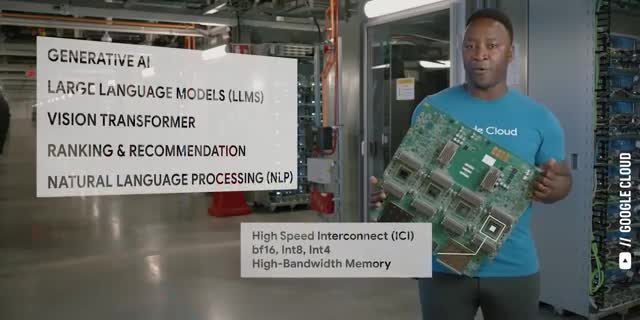
And if someone else makes a breakthrough in any layer, a better model, a faster chip, or cheaper cooling, Google can pull it straight into their own stack without having to ask a supplier for permission. No other company can do that. On July 3rd, Google published an investor presentation explaining exactly why this matters. This presentation actually marks 10 years since Google launched their TPUs. Remember how training and inference are completely different jobs? Well, Google split their 8th generation TPUs into two separate chips, the 8T for training and the 8I for inference, which they could only do because they own that layer of their stack. Optimizations like these reduced the serving costs for Gemini by 78% last year alone.
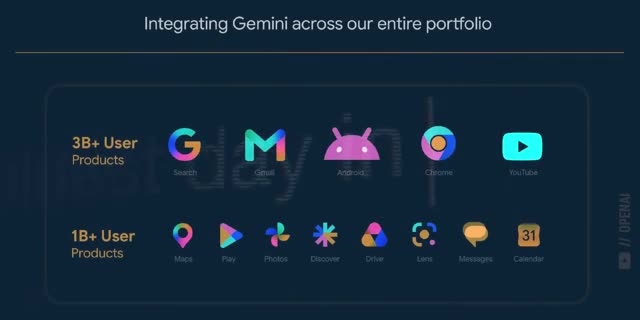
And the costs of core AI responses fell by another 30% since the launch of Gemini 3 last November. But as you know, when the costs for something drop, overall demand and spending rise even faster, since more people will use it more often for more use cases. That's called Jevin's Paradox, and this is the ultimate example. Gemini now powers 13 different products and services with over a billion users each. AI Overviews reaches over 2.5 billion people every month. AI Mode passed a billion monthly active users a year after it launched, and the Gemini app crossed 900 million monthly active users, more than doubling year over year, while over 8.5 million developers are building on top of Google's models every month.
Key Takeaways
Oh yeah, and Gmail's security systems block 10 million spam emails every single minute. As a result, the total amount of tokens that Google processes each month grew by more than 300x over the last two years, and they now process over 3.2 quadrillion tokens a month. To put that in perspective, that's the equivalent of about 800 full-length HD movies every single second, 24-7. So, even though their model costs fell by more than 75%, the total costs of running it are still rising fast. That's the technology answer. Now let's talk about the money answer.
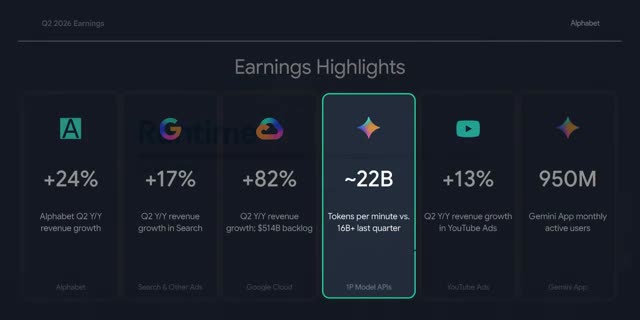
Alphabet reported earnings on July 22nd, 7 weeks after that investor presentation. And almost every number I just covered grew faster than I expected. The Gemini app went from 900 million monthly active users to 950 million. They went from processing 19 billion model API tokens per minute to 22 billion. Google Cloud's backlog grew from $462 billion to $514 billion. That's not a mistake. Their backlog is over half a trillion dollars. And revenues came in at $120 billion for the quarter, up 24% year over year. That's Google's 12th straight quarter of double-digit growth. But this headline number was hiding something big. Their net income jumped nearly 300% to $112 billion. But $99 billion of that came from gains on stocks that the company owns, mostly Anthropic and SpaceX.
Google invested about $900 million into SpaceX back in 2015. and that stake is worth $94 billion after the IPO. But here's the catch, they can't sell a single share. That $94 billion is what the stake was worth on June 30th, the last day of the quarter. But $80 billion of that is still in SpaceX's lockup period, which releases in stages between now and December 8th, and the other $14 billion stays frozen until quarter three of next year. But SpaceX is down by about 25% in the last month alone. So Google's share is worth significantly less today. So if we strip out those paper gains out of their earnings, they actually had about $2.85 in earnings per share, which was actually below Wall Street's expectations. And their operating income grew by 30%, not the 300% reported by the headlines.
But even with all that I think Wall Street is making a big mistake on this stock because everything we just walked through the models the chips the data centers and the network shows up on one line of this earnings report google cloud google cloud revenue came in at 24.8 billion dollars for the quarter which is up 82 year over year most analysts think that a business of this size has to have slower growth because it's already so big but But Google Cloud is actually accelerating. Revenues grew by 48%, then 63%, and now 82% year over year. And their operating income still tripled from $2.8 billion a year ago to $8.8 billion today. That means their operating margins went from about 21% to 36% in a single year. So they're making much more profit while almost doubling in size.

But the biggest thing in the earnings report for me was a single sentence that I've never seen before. Google Cloud generates product revenues primarily from the sale of TPU systems. This is the first quarter that Alphabet recognized revenues from selling their TPUs, meaning Google is directly selling their custom chips. Neither Microsoft nor Amazon do that today. For a decade, TPUs were something you could only rent through Google Cloud. But today, they're being installed directly in other companies' data centers. And I expect these product revenues to ramp up significantly over the next few quarters, especially with their $514 billion backlog. But all this growth comes at a serious cost. Google spent $45 billion in the second quarter alone, on land, buildings, chips, and cooling.
That's literally double what they spent this time last year. On top of that, Google increased their already astronomical CapEx budget from $185 billion at the midpoint to $200 billion for 2026. That's their second spending increase so far this year, and management already said that spending in 2027 will be much higher than that. In fact, Alphabet signed a whopping $811 billion in future purchase agreements, chips, equipment, data centers, and electricity that they're contractually obligated to buy. $200 billion of this is due in the next year, and three months earlier, the whole number was $332 billion. dollars.
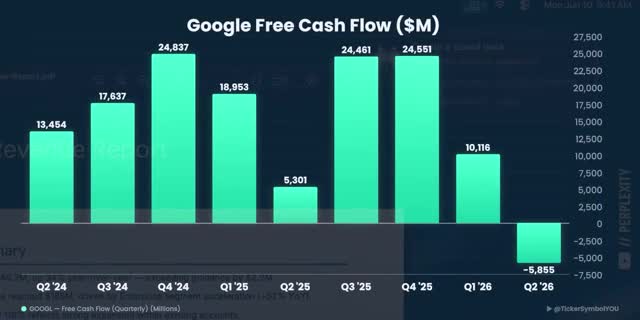
Fun fact, some of this money is for energy contracts that run until 2054, which means Google signed electricity bills that are due 28 years from now for data centers that don't even exist yet. That's how serious this AI race is becoming. And it also had a serious impact on their free cash flows, which came in at negative 5.9 billion dollars for the quarter. Two quarters ago, that That number was $24.6 billion. In the last quarter, it was still above $10 billion. Today, they're burning money, issuing new shares, selling long-term bonds, and they've stopped buying back shares for the first time since 2017. Their long-term debt more than doubled in the last 6 months. And their interest bill basically 5X'd. No wonder the stock fell 7% the day after earnings.
Alright, so after everything we covered in this video, here's my personal opinion on Google stock. Google is spending a lot of money, like an absolutely insane amount of money. But this is a company that serves billions of people every single month, across every single kind of device and online service. Google Cloud is growing faster than Microsoft Azure and Amazon Web Services put together. They have a backlog worth more than half a trillion dollars, and they just started selling physical chips to other companies. So while analysts see a company that went from being one of Wall Street's safest picks to one of the world's biggest burners of cash, I see the only company on earth that can actually justify this level of spending. Exactly because they own every single layer of their AI stack.
The model, the chips, the data centers, the networks, and even the browser window that this video started with. Google isn't burning money. They're investing in themselves. And to me, that's the best way to get rich without getting lucky. And if you want to see what other stocks I'm buying to get rich without getting lucky, check out this video next. Either way, thanks for watching and until next time, this is Ticker Symbol U. My name is Alex, reminding you that the best investment you can make is in you.
Checkout our YouTube Channel
Get the latest videos and industry deep dives as we check out the science behind the stocks.