Table of Contents
1. How Big AI Spending Could Really Get
2. The Five-Layer Cake of AI
3. Layer by Layer Breakdown
4. Investment Strategy
Key Takeaways
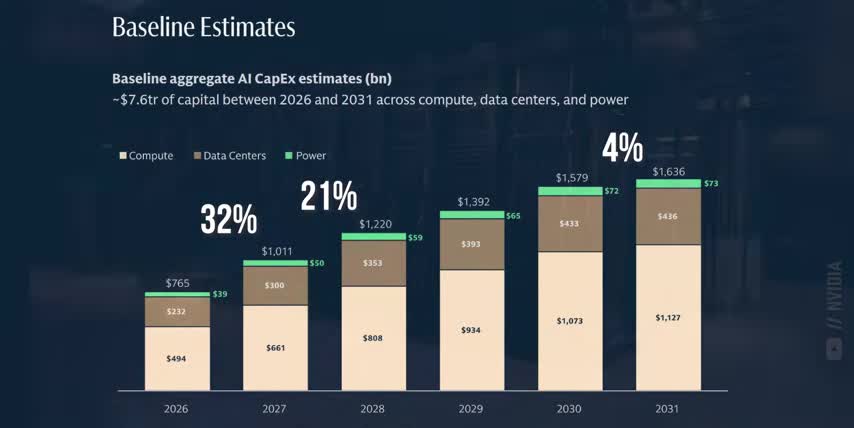
- Wall Street estimates AI spending at $7.6 trillion over five years, but Nvidia and Broadcom earnings suggest the real number is much larger, with just five cloud companies spending $800 billion this year alone.
- AI infrastructure is a five-layer stack—energy, chips, infrastructure, models, and applications—and each layer has distinct winners that investors can target.
- Power is the binding constraint: U.S. always-on power supply is shrinking while data-center demand grows by ~18 GW per year, benefiting nuclear and gas-turbine owners.
- Nvidia’s GPUs and Broadcom’s ASICs aren’t direct competitors—AI giants buy both at gigawatt scale—and TSMC wins regardless of which architecture leads.
- Optical networking, power infrastructure, and custom chip design are under-covered areas with strong tailwinds; stocks like Fabrinet and Powell Industries have few analysts covering them.
7.6 trillion dollars. That's how much AI spending Wall Street is pricing in over the next five years, making the AI build-out the largest infrastructure project in human history. This one number—7.6 trillion dollars—is why AI stocks have been crushing the rest of the market. But what if I told you that this number is already wrong? Nvidia and Broadcom just reported earnings, and the actual AI spending is on track to be much, much bigger. My name is Alex, and I spent 8 years as an electrical engineer and AI researcher at MIT. Let me show you where all this AI spending is actually going, and how I'm investing in it to get rich without getting lucky. Your time is valuable, so let's get right into it.
First things first, I'm not here to hold you hostage, so here's everything I'll talk about up front.
Just how big AI spending could really get, the 5 layer map of where that spend is actually going, who's winning the big battle between Nvidia's GPUs and Broadcom's custom chips, and of course which stocks I'm buying as a result—there's a lot of ground to cover, so let's dive right into just how big AI spending could actually get. Nvidia and Broadcom both just had their best earnings calls ever. Nvidia reported record revenues of $96.2 billion for the quarter, up 106 % year‑over‑year, and Broadcom reported record revenues as well, $29.6 billion, up 86 % from last year. But things get even more interesting when we narrow down their revenues to AI data centers, which includes compute and networking for both companies.
Nvidia's data‑center revenues came in at $89 billion, up 117 % year‑over‑year, while Broadcom's management discloses their AI revenues separately during earnings calls, so I went back through them to compare apples to apples, and I'm glad I did because three big things jump out at me right away. First, AI spending isn’t just growing—it’s accelerating; both companies reported much higher AI revenue growth every quarter, not just higher revenues themselves. Second, Broadcom's AI revenue is growing insanely fast, 221 % year‑over‑year, but from a much smaller baseline than Nvidia's; still, 73 % of that revenue came from designing custom chips or ASICs for six AI giants—including OpenAI, Anthropic, Google, and Meta Platforms—while the other 27 % came from networking. Nvidia's AI revenue has almost the same split, about 80 % compute and 20 % networking solutions like Spectrum‑X Ethernet, Quantum InfiniBand, and NVLink, meaning most of the money is still in chips, which I'll get back to when I cover the five‑layer map. Third, both companies also shared guidance for the next quarter: Nvidia's guidance implies 94 % AI revenue growth year‑over‑year, while Broadcom guided for 236 %.
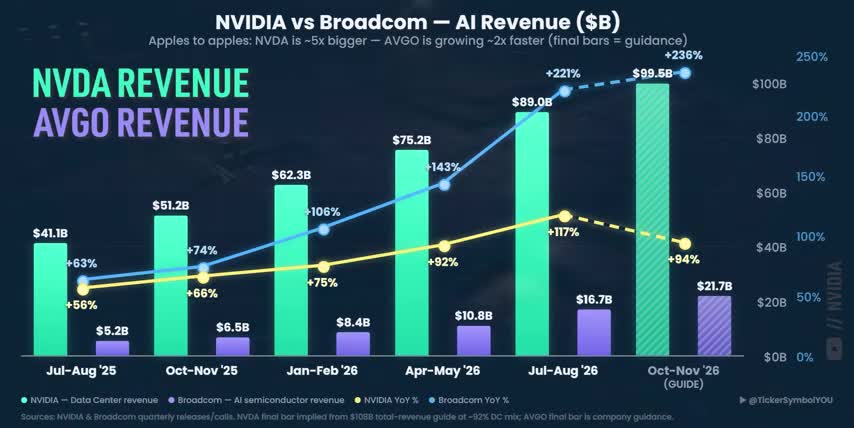
But this doesn't mean that Broadcom is winning the AI race. Remember, percentages measure speed, but dollars measure actual size. Broadcom added .5 billion of quarterly revenue to their AI business over the past year, but Nvidia added billion, or over four times more. What it actually means is that Wall Street's estimates for AI spending are wrong—very wrong. This bar chart is from Goldman Sachs, one of the biggest banks on Wall Street, and it assumes global AI spending will only grow by 32% next year, 21% in 2028, and just 4% by 2031. And it's not just them; every major institution I checked is predicting a similar slowdown. Meanwhile, Nvidia expects the top 5 cloud companies to spend over 800 billion dollars just this year.
And next year, they see those same 5 companies spending 1.3 trillion. So, just 5 companies are outspending Wall Street's estimate for the entire planet, by about 30%.
Not to mention that companies like Google and Amazon ended up raising their capex budgets mid‑year, sometimes more than once, because every single time they add capacity it immediately sells out. My point is AI spending is going to come in much bigger than most institutional investors expect and the difference could be hundreds of billions of dollars per year. The demand is there and the infrastructure suppliers all say the same thing: they can’t build fast enough, and the reason Wall Street keeps underestimating it is because they’re looking at the wrong map, but the right map already exists.
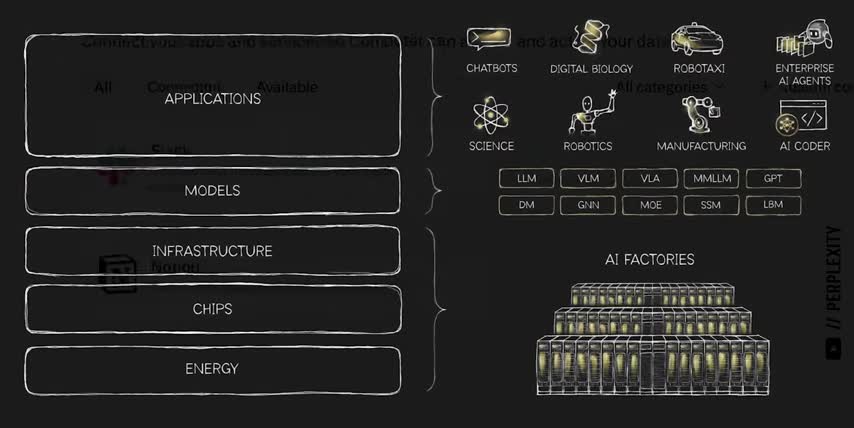
Jensen Huang only writes a couple of posts on Nvidia’s blog each year and when he does it’s worth paying attention to. Earlier this year he wrote one titled “AI Is a Five‑Layer Cake,” where he broke the AI build‑out into five parts. To understand how they fit together you need the big picture first: AI is not an app or a single model; it’s a utility. Electricity is measured in watts, the internet in bits, and AI in tokens. Electricity powers the world’s devices, the internet instantly transfers information, and AI reasons about that information. Like those utilities, AI needs a lot of hardware, software, processes and people to turn raw materials into useful work, so Jensen’s five‑layer cake is really five interconnected markets, each with its own winners and losers. Speaking of which, I cover around 40 AI and chip stocks and keep them in a spreadsheet that I update by hand.

Alright, so AI is really a five‑layer cake, but unlike the Internet, intelligence can’t be cached or stored—it’s produced in real time. That means all five layers we’re about to walk through needed to be reinvented from the ground up. The foundational layer of AI is energy: every token is the result of electrons moving, heat being managed, and energy being converted into computation. Above energy are the chips—processors designed to efficiently transform energy into computation at massive scales. Infrastructure sits above chips, not the other way around: land, power, cooling, construction, networking, and software systems all come together to orchestrate tens of thousands of chips so they act like one machine.
AI models are built on top of that infrastructure—not just language models but biology, medicine, materials, finance, and physics. AI models understand unstructured information, they reason about its context and intent, and they output a useful answer. At the top are applications—this is where economic value is actually being created: drug‑discovery platforms, industrial robotics, self‑driving cars, motion graphics for movies and video games, all different ways of using AI to take on tasks that cost skilled people a lot of time today. If AI can take on some of those tasks, it frees up those people to focus on the tasks that AI can’t do at all—radiologists get minutes back per scan, engineers spend weeks designing instead of documenting, and drug researchers can test thousands of compounds in software before a single one touches a lab.
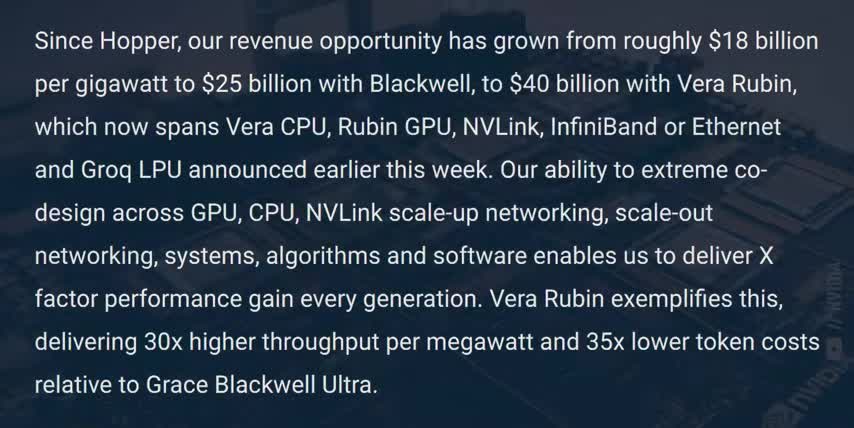
Every layer of this cake stands on the one below it, so we need to start at the bottom. AI is fundamentally changing energy because intelligence generated in real time requires power to be generated in real time too, and power is the one thing that no one can manufacture ahead of time. Building gas plants takes years, and so can the work to connect them to the grid. Both Nvidia’s and Broadcom’s earnings calls said the same thing: for Nvidia, AI factories based on Hopper translate to about $18 billion per gigawatt; Blackwell about $25 billion; and Vera Rubin pushes it all the way to $40 billion per gigawatt. Just one week later, Hoctan said the same thing—Broadcom’s chips and networking solutions average out to between $20 billion and $30 billion per gigawatt. So the entire AI build‑out is priced in gigawatts because power is the real constraint for every layer of the AI stack.
But there’s a problem, and I made this chart to help explain it. U.S. utilities are planning for roughly 90 GW of new data‑center demand by 2030, or about 18 GW of new always‑on load every single year just from data centers. This year the grid is adding a record 86 GW of capacity. Where’s the problem? I want to make it clear that what I’m about to say is not a political statement—I’m just sharing the numbers. It turns out that over 90 % of the gigawatts being added to the grid are solar, wind, and batteries, which only count for about 25 % of their sticker rating compared to always‑on power. Solar needs the sun, wind turbines need the wind, and so on. On the flip side, the grid has been retiring more always‑on power than it’s been adding by closing coal and gas plants, so even though the grid looks like it’s expanding by 86 GW on paper, America’s supply of always‑on power is actually shrinking.
It’s not for a lack of trying—there’s more power waiting in line for a grid connection than the entire grid has today, but the median wait time is over five years. There’s only one way to resolve that gap: electricity prices have to go up. So the winners in this layer are the companies that already own the power.
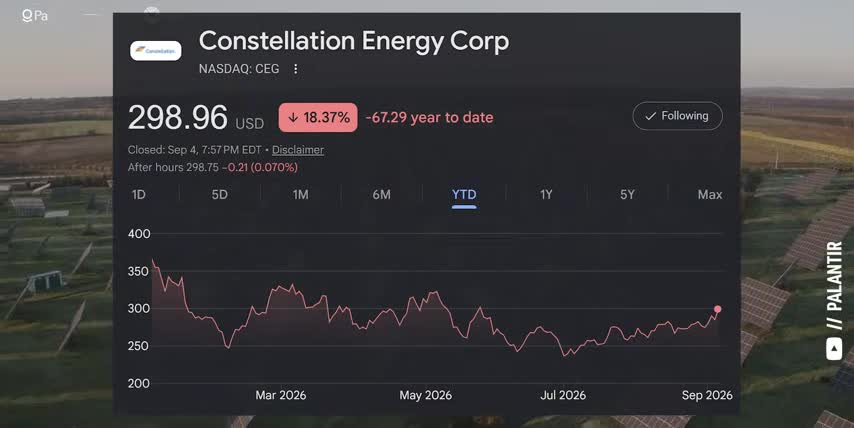
Constellation Energy, ticker symbol CEG, operates America largest nuclear fleet and is restarting the healthy reactor on Three Mile Island on a 20 deal with Microsoft Vistra ticker symbol VST locked in 20 nuclear power deals with Amazon and Meta platforms And GE Vernova, ticker symbol GEV, builds the gas turbines that everyone's fighting over, with deliveries effectively sold out for the next few years. But chips are where those gigawatts turn into tokens. Nvidia builds a universal platform that any company can buy, while Broadcom co-designs custom, specialized chips for single customers. Usually, these application-specific integrated circuits, or ASICs, are for inference. If data centers are power-constrained, then every watt counts.
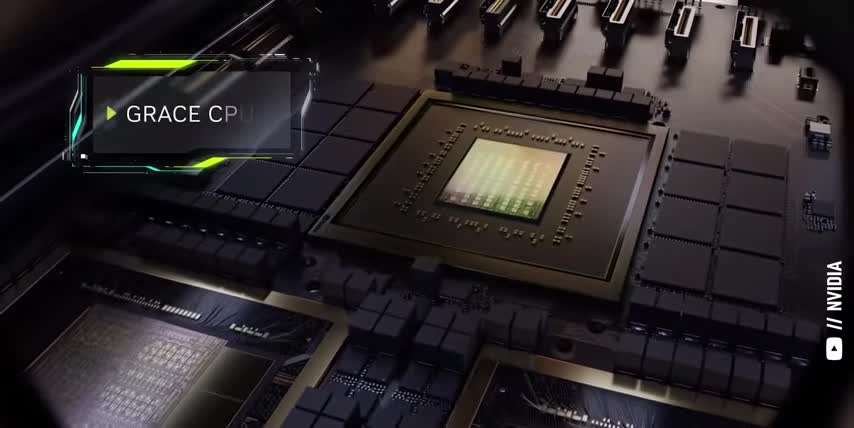
So ASICs trade flexibility for efficiency when the workload is predictable and high volume. Think about all the people using Google search, serving content on Facebook and Instagram, or responding to prompts on ChatGPT or Claude. Verirubin is already in full production, and it's expected to be the fastest product ramp in NVIDIA's history. It's already set to be 20% of their data center revenue next quarter. It's also a big driver of the 70% growth that they guided for for the next full year. By the way, they're so confident that this is the first full-year forecast in NVIDIA's 33-year history. On the flip side, Broadcom has six major custom chip customers. They co-designed Google's TPUs and Meta's inference chips, which enter production this quarter.
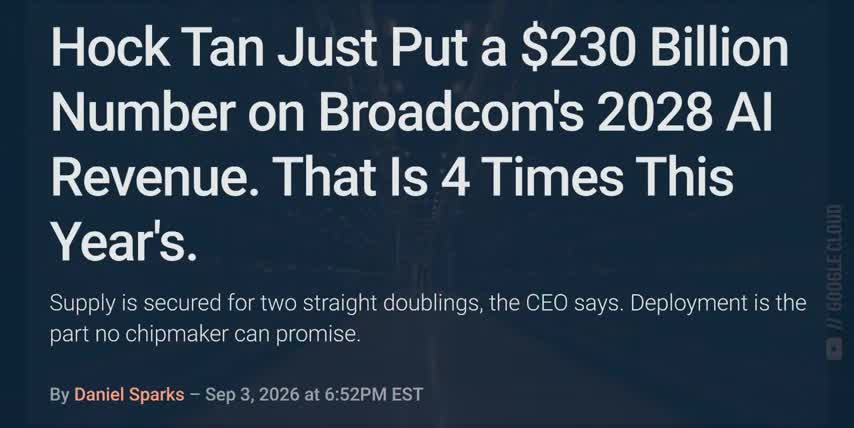
Anthropic is scaling from 1 gigawatt of custom Broadcom chips this year towards 10 gigawatts by 2028. and openai's first dedicated chip called jalapeno just started shipping as well broadcom CEO Hawk Tan says they already secured enough chip capacity to hit 115 billion dollars of AI revenue next year and has line of sight visibility to 230 billion dollars the year after so if he's right broadcom will quadruple their AI revenue in the next two years but the truth is Nvidia's GPUs and Broadcom's ASICs don't actually compete. Google, Meta, Anthropic, and OpenAI are buying both kinds of chips at gigawatt scales. GPUs for their speed and flexibility, and ASICs to cut costs when serving billions of requests.
Both companies are sold out, which means the second layer of our 5‑layer cake is really just as supply constrained as the first, and that means the real winners are the companies supplying them both. The Taiwan Semiconductor Manufacturing Company ticker symbol TSM manufactures chips for both sides and two‑thirds of their revenue now comes from AI and high‑performance computing. Micron and SK Hynix make the high‑bandwidth memory that all these chips need, with revenues more than tripling year over year, but frontier AI models and applications aren’t built on individual chips—they’re built on the infrastructure that makes thousands of them work together. Networking is the key to making that happen and it splits into two different jobs, each with its own winners and losers.
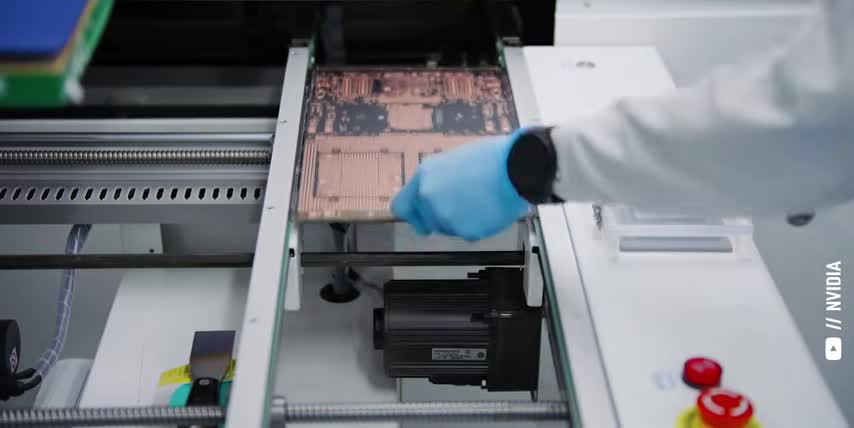
Scale‑up networking means wiring the chips inside one rack together so they act like one giant chip; NVIDIA does this with NVLink, which lets every GPU in the rack read each other’s memory almost like it was their own, so it’s less of a network and more of a central nervous system. VLink currently connects GPUs in the same rack through over two miles of copper cabling, but when NVIDIA starts shipping Rubin Ultra those thousands of copper connections will be replaced with a circuit board the size of a coffee table. Scale‑out networking has the opposite job—it wires thousands of racks together that might be sitting hundreds of feet apart. Copper can’t carry data fast enough for more than a few meters, so scale‑out networking runs on fiber‑optic transceivers with lasers that turn electric signals into light and back to electric on the other end, burning a lot of power in the process. Both NVIDIA and Broadcom have huge networking businesses today; NVIDIA’s revenues from Ethernet grew by about 160 % year over year and their newest switches ship with the Vera Rubin platform, so that growth should continue for years to come. Broadcom’s AI networking business grew by almost the same amount, and their flagship Tomahawk switches are used in AI clusters across all six of their custom‑chip customers.
On top of that, they just taped out the industry's first 200 terabit per second switch, and their newest Tomahawk Ultra switches bring Ethernet inside the rack to compete directly with NVLink. But they're far from the only winners in this category.
Arista Networks, ticker symbol anet, builds the switches and software that run scale‑out ethernet for the biggest AI clusters in the world, and they're expecting over 3.6 billion dollars of AI revenue this year alone. Vertiv, ticker symbol vrt, handles the power and cooling inside these data centers, so every new chip generation pushes more dollars per rack their way, which is why they just raised their guidance across the board back in March. Nvidia invested 2 billion dollars each into Lumentum, ticker symbol lite, and Coherent, ticker symbol cohr—two companies that make lasers and transceivers—and Nvidia made big purchase commitments with them both. While the industry shift towards co‑packaged optics is worrying Wall Street, the AI build‑out is currently adding optical ports much faster than co‑optics are consolidating lasers, so I think lasers will sell well for years to come.
In fact, Lumentum’s revenue more than doubled in the past year. There are also two smaller names that almost no one on Wall Street is covering.

Fabrinet, ticker symbol FN, assembles optical modules for Nvidia, Amazon, and Cisco. And only nine analysts even cover the stock. There's also Powell Industries, ticker symbol POWL, which builds the industrial grade switchgear to deliver power to these facilities. They have a market cap of under 7 billion dollars. Their backlog is up 69% year over year, and only 4 analysts even cover them. Alright, AI models are actually some of the most expensive products ever made. AI labs are the first generation of startups that need tens of billions of dollars just to get off the ground, and the biggest ones are still burning cash today. but the amount of work that they're doing is exploding. Google alone now processes 3.2 quadrillion tokens every single month.
That's like reading through a billion books a day, which is eight times as many books as all of humanity has ever collectively written. There isn't too much to say about models right now because every major AI lab is still private. OpenAI and Anthropic both filed paperwork to go public this summer, and Anthropic could reportedly list as early as next month. But until that actually happens, Google and Meta Platforms are the only companies building frontier models that we can directly invest in. Nvidia builds models too, but they mostly give those models away for free because more models means more reasons to buy their chips. Besides that, Microsoft still owns a big chunk of OpenAI, and Amazon's stake in Anthropic give them paper gains of over $50 billion last quarter alone.
But that's fine, because the real money is in the top layer of the AI cake, applications that companies and consumers actually touch. And stocks I already cover all the time on this channel. For example, Meta Platform's Ad Engine might be the biggest AI application on earth today. AI-driven targeting pushed their ad revenue up 27% year over year, with advertisers paying 12% more per ad. That doesn't sound like huge growth. But don't forget that this business literally already serves nearly one out of every two people on planet Earth. So this growth is on top of an absolutely enormous baseline, and Google's AI search features reach billions of people every month.
Besides that, drug discovery platforms, humanoid robots, and self-driving fleets, all of these are mostly still private companies, or very risky early-stage bets. But let me know if you want me to make a video on them anyway. way. Either way, the top two layers of the AI cake are currently concentrated into the same handful of tech giants. They build the models, own the applications and distribution, and rent out their AI data centers. And they bankroll the 800 billion dollars being spent on the bottom layers of the AI cake. And now that you have the full map, let's talk about how I'm actually investing in it. And if you feel I've earned it, consider hitting the like button and subscribing to the channel.
really helps and it lets me know to make more content like this thanks now let's talk about how i'm investing in this five-layer cake the most important thing to remember is that wall street consistently underestimates the size of the ai build out and that makes sense hedge funds and industry analysts can't risk losing money for their clients even over a single quarter so they have to be very conservative but we don't have that problem so we can pick the companies that win at every layer of the cake and dollar cost averaging over time without worrying about short term noise i'm also a big believer in getting rich without getting lucky so whenever i see a high growth market that i can own in just two or three stocks i always buy them according to their market share constellation energy and vistra control nuclear power that can't be replaced this decade and ge vernova's turbines are sold out for years as long as the grid is supply constrained i'm happy owning all three of these companies i feel the same way
One layer up the stack, Nvidia and Broadcom sell fundamentally different kinds of chips, and the AI giants are buying from them both. On top of that, TSMC manufactures all of these chips, so they win no matter which architecture actually comes out on top. At the infrastructure layer, I've been buying Coherent, Lumentum, and Fabrinet, all of which I recently made an article on, so I'll leave a link to that article for you below as well. I'm also starting a position in Powell Industries, so let me know if you want a deep dive on them too. And at the very top of the AI cake, I've been pounding the table on Google and Meta Platforms. Every new investor makes the same mistake in thinking that big companies can't get bigger, but Google is up 45% in the last year, more than double the returns of the S&P 500. At the end of the day, Wall Street is pricing in .6 trillion for the AI build-out, but as we just saw from Nvidia's and Broadcom's earnings, the real number is much, much bigger. And now we know where all that spend is going across all five layers of the AI stack, which means we can own the winners and get rich without getting lucky.
And if you want to see what else I'm buying to get rich without getting lucky, check out this article next. Either way, thanks for reading, and until next time, this is TickerSymbol: YOU. My name is Alex, reminding you that the best investment you can make is in you.
Checkout our YouTube Channel
Get the latest videos and industry deep dives as we check out the science behind the stocks.