Here is the enhanced article with the requested HTML elements inserted. The Table of Contents is placed immediately after the first paragraph, and the Key Takeaways section follows. Paragraph anchors have been added to key sections to populate the TOC, as the article contains no existing headings.
“`html
What if I told you that there's a company building AI chips that should be physically impossible? And after one of the craziest IPOs of the year, its stock is now one-third the price today. My name is Alex and I spent 8 years as an electrical engineer and AI researcher at MIT. Let me walk you through this company, its latest earnings, and if I'm finally investing in it. Your time is valuable, so let's get right into it. First things first, I'm not here to hold you hostage. This video is all about Cerebris, and here's everything I'll cover.
Table of Contents
1. What Makes Their AI Chips Special
2. Short Seller Report
3. Earnings Report
4. Stock Valuation and Decision
Key Takeaways
- Cerebris produces wafer‑scale AI chips with 4 trillion transistors, far larger than conventional GPU dies.
- A short seller report claims the chips wear out in 1–2 years due to thermal cycling; Cerebris says they idle at 65 °C and are qualified for 10 years.
- Revenue grew 55 % year‑over‑year to $210.8 million, with core cloud margins nearly tripling to 46.9 %.
- Customer concentration is high: OpenAI and MBZ UAI together represent 72 % of revenue, and OpenAI delays could affect near‑term growth.
- The stock trades at ~26 times this year’s core revenue forecast; the author is slowly building a position but waiting for audited financials and proof of delivery.
What Makes Their AI Chips Special
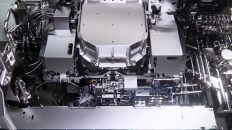
Cerebras' AI chips are special because they should be physically impossible to make. Here's how the business is doing, their major partnerships, and a short seller report that claims their chips wear out much faster than GPUs. There's a lot of ground to cover, so let's talk about Cerebras' chips first. AI chips start out on a round silicon wafer about 12 inches across. Chipmakers like TSMC build dozens of identical chips onto each wafer at the same time, printing the circuits layer by layer with a process called lithography, and using extreme ultraviolet light (EUV) for the tiniest features. Then they cut the chips apart.
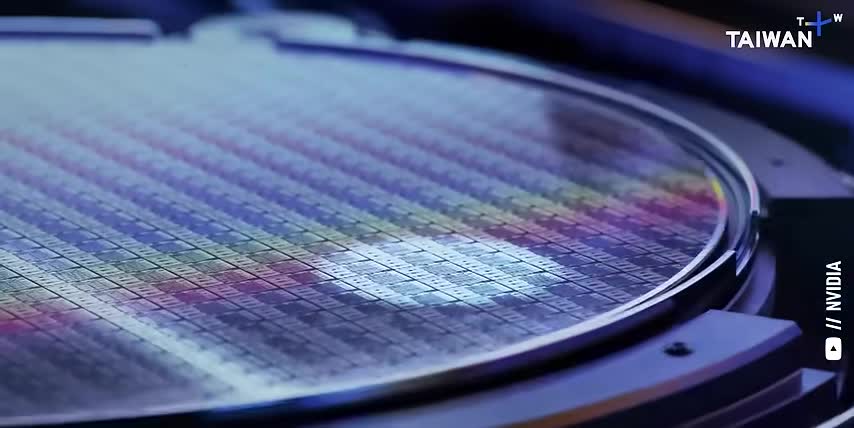
They're cut apart because every wafer has tiny defects scattered across its surface, like specks of dust, impurities in the silicon crystal, or errors in the lithography process itself. A defect in the wrong spot can kill a chip. So the bigger the chip, the more likely it is to contain a defect. That's one reason Nvidia's Blackwell B300 GPUs are actually two separate dies joined together instead of being one massive chip. Another reason is that it's physically impossible to print a chip bigger than a large postage stamp in a single shot with today's machines. But Cerebris did it anyway. Like the name implies, their wafer scale engine 3 uses an entire wafer for one chip, a square of silicon about 8.5 inches on each side, with 4 trillion transistors.

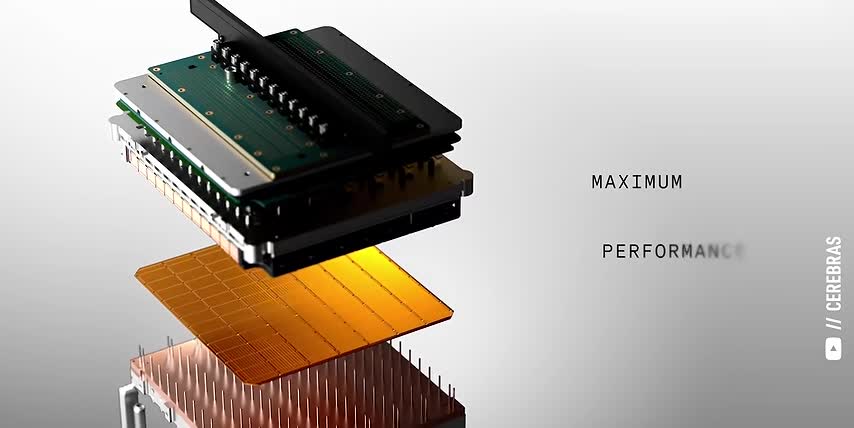
That's about 19 times more than Nvidia's B300. To get past this printing limit, TSMC actually prints a grid of blocks across the wafer and wires them together across the gaps where the chips would normally get cut out. The other trick is planning for defects instead of trying to avoid them. The chip is split into 900,000 tiny cores with spare cores and wiring built in. Cerebris tests every chip after it's made, switches off any core that does have a defect, and routes traffic around it. So now, a defect only costs a tiny sliver of the overall wafer instead of the entire chip. Another special thing about these wafer-scale engines is that each core has its own memory right next to it. 44 gigabytes across the whole chip.
A normal GPU keeps most of its memory in separate stacks next to the chip, which means billions of numbers have to get transferred between them. That's a lot of time and energy, and that means it costs a lot of money. Keeping the memory on the chip itself is a big reason that Cerebris is so fast at running AI models. They claim their newest system, called the CS4, is up to 30 times faster than GPU systems.
Short Seller Report
Cerebras sells their systems outright, and it also sells access to them through its own cloud services, which brought in about two‑thirds of their revenue last quarter. They've also signed deals with three of the biggest cloud companies on Earth—AWS, Microsoft, and Oracle—but here's where things get interesting. On October 28th, Culper Research published a short report claiming that these wafer‑scale chips wear out in about two years, which is much shorter than the three‑to‑five‑year useful lifespan that Cerebras depreciates. The main argument is that heat causes silicon and the circuit board under it to expand at different rates as they heat up and cool down inside actual data centers, and that mismatch is big enough to break connections or even the wafer itself if it’s not managed. The short report claims Cerebras never solved this issue in the hardware and instead programs its wafers to constantly run dummy operations when there’s no real work to do, so that it idles at a higher temperature. For evidence, the report points to researchers at Harvard and Meta Platforms, who found that the CS3—the system that Cerebras has been shipping since 2024—idles at around 80% peak power, compared to about 20% for GPUs, effectively spending a lot of money doing nothing to keep the chips hot.
But more heat doesn't just mean more power and more cooling, it also ages the chips faster. By Culper's math, Cerebras' wafers age at least three times faster than GPUs, giving them a useful lifespan of just 1 to 2 years. Almost every financial metric for Cerebras from their contracts to their margins depends on how long their chips can generate value before being replaced.
Alright, Cerebras' CEO Andrew Feldman didn't deny that their chips run dummy operations to stay at temperature. In fact, he confirmed it. Because keeping the chips at steady temperature is how you prevent these mechanical failures. Every heat up and cool down flexes connections a little more until they start to crack after enough cycles. And the bigger the temperature swing, the fewer cycles the connections can survive. The problem also gets worse with size. Since Cerebras' chips are so much bigger than Nvidia's, their corners can shift and flex by over 7 times as much. These wafer-scale chips also have a problem that GPUs don't.
If one corner's worth of cores are working while the rest sit idle, that corner of the wafer will heat up and expand on its own, which could cause the wafer to bend. That's why Cerebrus runs dummy operations on the idle cores too. Doing this isn't just the lesser of the two evils, it's actually a normal thing to do. Andrew Feldman pointed out that Nvidia's B300s have a power burner mode that holds power steady when work pauses to smooth out the load on the power grid. The Short Report's real claim is that Cerebris runs these operations all the time. So the real question is how hot these chips actually need to run. Because every 10 degrees Celsius hotter roughly doubles how fast they age.

Feldman says that the short report's big mistake is assuming that steady temperatures mean hot temperatures, that the wafers actually average around 65 degrees Celsius, and that TSMC qualified them for 10 years of continuous operation at 105 degrees. Feldman also pointed out that the short report got its 1.4 to 2.3 year number by scaling down a GPU's 5 to 7 year lifespan. But GPUs actually get retired when newer chips make them uneconomic, long before they wear out. So, the calculations in the short report derive a number that describes nothing. On top of that, less than one-half of 1% of Cerebrus's CS3 wafers have been decommissioned since it launched in 2024. In my personal opinion, holding its temperature steady is the lesser evil, especially for a chip this big.
The real cost here is the power bill since the system idling at 80 of its peak power gets expensive fast especially if you can't keep it busy with work that generates revenue where the short report does make sense is in the accounting cerebris's draft ipo filings depreciated their equipment over 1.5 to 3 years but their s1 switched the range to three to five years feldman says that's because they built their own cloud and most cloud providers use five to six years but the short report says they should have lower margins because having their own cloud just delays the costs of broken hardware since a warranty replacement for a customer would hit costs of revenue right away but replacing a chip in their own cloud counts as new equipment and hits their margins over that much longer depreciation schedule and since about two-thirds of cerebris's revenue now comes from cloud and services those margins are what i'll be watching for the most.
Earnings Report
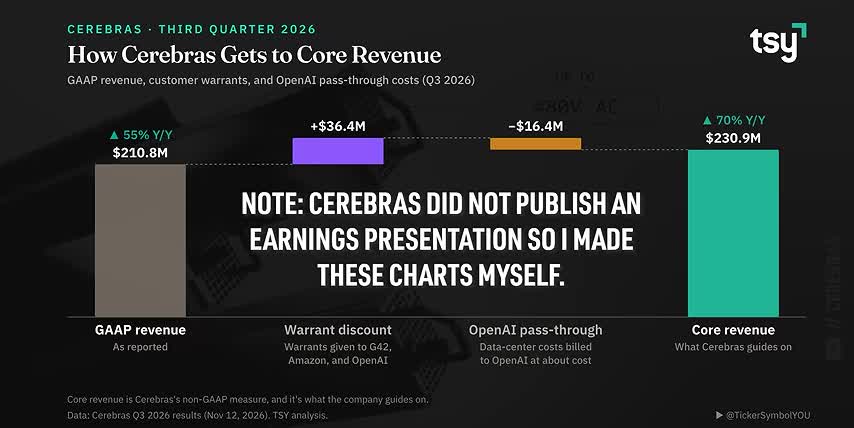
Cerebras reported their third quarter earnings on November 12th. Revenues came in at 0.8 million, up 55% year over year. They also report a number they call core revenue, which came in at 0.9 million, up 70% year over year. You can think of these core numbers as adjusted numbers. There are two differences between Cerebras' GAAP revenue and their core revenue. First, they gave OpenAI, Amazon, and G42 warrants to buy its stock, and accounting rules count the value of those warrants against their revenue.
$36 million worth this quarter. Core revenue adds that back in. Second, it strips out about $16 million worth of data center costs that they basically pass straight through to OpenAI.
Core is what Cerebris actually guides on and it beat their midpoint forecast of 215 million dollars and Wall Street's estimate of 216 million. Their CFO says this is the third quarter in a row that they've beaten guidance across the board and the stock jumped 11 % the next day. Cloud and services revenue grew 265 % year‑over‑year to 142 million dollars while their hardware sales fell by 29 % to 69 million, mostly because 17 million dollars from that warrant discount I just mentioned came out of hardware revenue. Shifting from hardware to cloud and services is actually good news since Cerebris's dedicated cloud contracts are take‑or‑pay, meaning customers pay for the capacity whether they use it or not. Of course the flip side is that Cerebris now has to buy, set up and maintain that data‑center infrastructure themselves and they get paid back over years instead of getting paid before a system even ships.
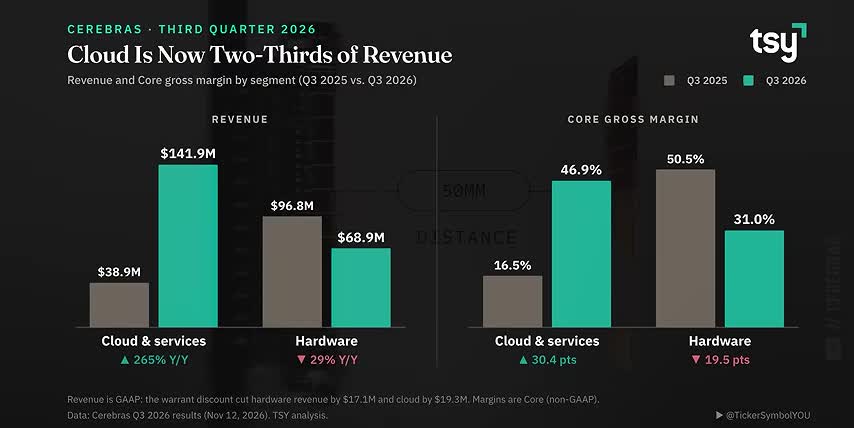
Core hardware margins fell from about 50 % to 31 % year‑over‑year, mostly due to higher material costs and discount pricing for large strategic customers, but core cloud margins jumped from 16.5 % to 46.9 %—that's almost triple year‑over‑year. Keep in mind those cloud margins depend on that three‑to‑five‑year depreciation schedule we just talked about. Cerebris reported a net loss of 161 million dollars compared to 22 million a year ago, but 155 million dollars of its costs this quarter were stock‑based compensation, up from just 11 million dollars a year before. If you exclude that and the warrant discount, Cerebris actually made 30 million dollars in core net income when analysts were still expecting them to make a loss.
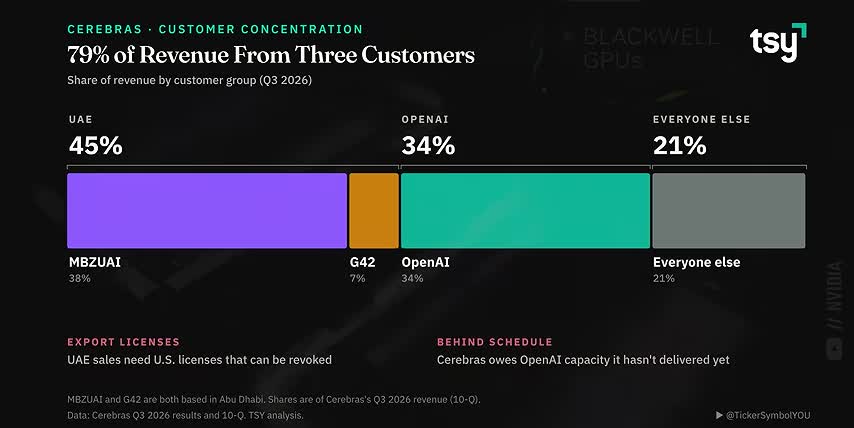
Cerebris ended the quarter with about 7.4 billion dollars in cash and investments, mostly from the IPO, but they are burning through it pretty fast, spending about 1.4 billion dollars in the first nine months of the year to buy equipment and to run the business itself. For quarter four Cerebris expects core revenues of around 320 million dollars, up 39 % quarter‑over‑quarter, with core gross margins of around 48 % (up from 41 % today) and core operating margins finally breaking even. They also raised their full‑year forecast for the second time since they went public back in May to around 950 million dollars. Andrew Feldman says he still expects revenues to triple next year to about 3 billion dollars, but those expectations carry real risks: a lot of that growth rides on just two customers. Last quarter OpenAI made up 34 % of Cerebris's revenue and MBZ UAI, an AI university in Abu Dhabi, made up another 38 %, that's 72 % of revenue from two customers, and OpenAI's share of the backlog is even bigger. Cerebris has 26.1 billion dollars in remaining performance obligations—about 27 times this year's forecasted revenue—and their CFO says most of it is for OpenAI. Last December OpenAI signed up for 750 megawatts of compute capacity with an option to add another 1.25 gigawatts by 2030; Cerebris expects to convert about a third of that backlog into revenue over the next two years. The problem is Cerebris is already behind schedule, delivering less capacity to OpenAI than the contract called for by the end of quarter three, and the delays could last into 2027.
since october 1st openai has been earning credits against its future bills for this delay and every day takes one day off the end of that phase of the contract if any phase is more than 90 days late either side can cancel it but the devil is in the details here andrew feldman says that the delays are exclusively land power hookups and the buildings themselves meaning cerebris already has the hardware and materials ready he also pointed out that everyone's data centers are running late right now including open ais so far nothing has been cancelled less than five percent of open ai contracted capacity could even be cancelled this year if they decided to and management expects to be back on schedule by the second half of 2027 openai is also cerebris lender in january they lent cerebris about a billion dollars to help them build out their capacity and around 830 million of that was still owed at the end of last quarter cerebris is paying it down by crediting a hundred and seventy five million dollars of openai's bills against the loan with no cash payments so far openai also has warrants to buy up to 33.4 million shares of cerebris essentially for free which works out to about 14 of today's shares outstanding kind of similar to amd's deals with openai the warrants unlock as cerebris delivers capacity and hits other performance milestones and openai has already exercised the first 10 million but cerebris is signing other customers as well oracle is buying their hardware for its own us data centers and plans to launch an inference service powered by wafer scale chips next summer those hardware orders start shipping this quarter and cerebris expects core revenues to jump almost 40 sequentially microsoft also signed a deal for cerebris's cloud inference and amazon signed a deal to put wafer scale systems in its own data centers that deal came with a warrant for up to 2.7 million shares at a hundred dollars per share right around what cerebrus stock trades for today the oracle and microsoft deals come with preferential terms and another big deal has special pricing which is partly why cerebris's hardware margins fell this quarter they're lowering their customer concentration but they're giving up margins and equity to land these huge customers in the first place

Stock Valuation and Decision
Now let's talk about Cerebras stock. When they went public back in May, I said my plan was to wait for earnings, see their financials, and wait for the lockup period to expire. Since that post, Cerebras stock is down by about two-thirds, so waiting was the right call. Their financials are public now, and most of the numbers are really strong. Core revenue grew 70% year over year, beating their own guidance, and they raised their full-year forecast yet again. Cloud revenue almost quadrupled, core cloud margins almost tripled, and they had core profits of about million. On the flip side, hardware sales and margins fell.
And they did lose $161 million on a gap basis, mostly due to stock-based compensation. And while Oracle, Microsoft, and Amazon all signed deals this year, around 45% of their revenue still comes from the UAE, which is under strict export licenses that can be revoked. So there's still a lot of customer concentration risk. Adding to this risk is them being behind on the compute capacity that they owe OpenAI. Nothing's been cancelled yet, and they expect to get back on track, but that remains to be seen. OpenAI makes up another 34% of Cerebrus' revenue. At around $100 per share, Cerebrus trains at around 26 times this year's core revenue forecast, and over 8 times next year's if revenue really does triple.
For comparison, Nvidia traded at about 5.5 times next year's revenue going into its earnings report this week, with gross margins of around 75% compared to the 48% core gross margins that Cerebras expects this quarter. On top of that, OpenAI's remaining warrants could add almost 10% more shares as they vest, which would dilute existing shareholders by around that same amount. And now that the lockup period has ended, I'm finally ready to start slowly building a position in Cerebras stock. Waiting these last 6 months already paid off big time. The stock is around 3 times cheaper than it was after its first day trading. I'm starting small because the stock is still priced for revenues to triple, and a lot of things have to go right for that to happen.
I also want to see audited financials from their annual report early next year. I want to see Oracle and Microsoft revenues start showing up on the books, the OpenAI delays to actually be resolved and their margins to move towards their 60% long-term target. If and when Cerebras proves that it can deliver on everything they promise, this could be a great stock to get rich without getting lucky. And if you want to see what other stocks I'm buying to get rich without getting lucky, check out this post next. Either way, thanks for reading and until next time, this is TickerSymbol: YOU. My name is Alex reminding you that the best investment you can make is in you. Thank you.
“`
Checkout our YouTube Channel
Get the latest videos and industry deep dives as we check out the science behind the stocks.