The same thing causing this catastrophic decline in the Korea exchange is also affecting US stocks, not because of the businesses themselves, but because new reports are coming out saying that China has begun mass producing its own Immersion DUV lithography machines, with the first systems due later this year. machines are the size of a small apartment, and they contain hundreds of thousands of parts. Those parts all come together to print microscopic circuits onto chips using ultraviolet light. These machines can only run in cleanrooms, specialized sealed and filtered facilities with essentially zero dust in the air, because a single speck of dust landing on the wafer can interfere with the light and ruin the chip.
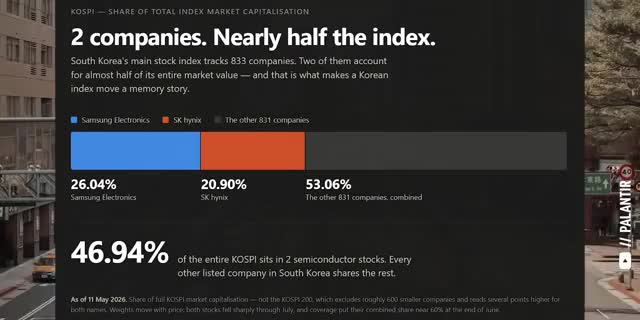
In fact, these machines are so specialized that essentially only one company on earth can even make them. ASML, a Dutch company that controls almost the entire global lithography market. Until now. Deep Ultraviolet or DUV lithography isn't precise enough to make the most advanced GPUs or AI processors with high enough yields, but it is precise enough to make memory, NAND flash memory, DRAM and even the dies inside high bandwidth memory that goes onto AI chips. But stacking those dies is a different problem altogether and a much harder one. And if China can mass produce memory, then Samsung and SK Hynix are in for a world of hurt, since they control around 70% of the current global DRAM market and close to 80% of the market for high bandwidth memory.
That's why they're crashing and they're taking every other AI stock down with them. Remember what I said a week ago when I told you this market shock was coming. These machines come in hundreds of crates and take months just to assemble. And after that, they still need to be calibrated, tested and tuned for the specific chips that they'll be making. And they aren't the only machine in the process. It takes dozens of individual machines and hundreds of individual steps to make memory. So China has to recreate the whole production process, not just one machine, and with high enough yields to actually compete.

So that begs the obvious question, should every AI stock go down just because there might be more competition for memory a few years from now? And the best way to answer that is by looking at the data. I think three kinds of companies are getting oversold in this correction. Memory, which is how all of this started, AI cloud companies that rent out compute instead of making memory, and quantum computing companies, which are a separate kind of company altogether. And the The thing is, all three kinds of companies are hitting major milestones while their stocks keep crashing Let start with memory On July 13 SK Hynix stock fell by more than 15 in a single trading day the worst day in the company more than 40 history Here what actually happened An analyst from Korea Investment and Securities published a research note explaining that most of SK Hynix's high bandwidth memory was locked under long-term contracts spanning roughly 3-5 years.
The prices in those contracts are fixed 12-36 months before the first chips even come off the production line. That means when memory prices go up, SK Hynix doesn't get to charge more for the memory that's already under contract. And memory prices have been going up a lot over the last quarter. Standard DRAM prices rose about 30%, and NAND flash memory prices rose around 50% quarter over quarter. So the big idea behind this analyst memo was that memory companies missed out on these price gains by locking in so much of their HBM sales through contracts ahead of time. So, SK Hynix had the worst market day in company history because memory got more expensive. Not cheaper, more expensive.

And speaking of expensive, you probably know that there are hundreds of data brokers collecting and selling your personal information. But did you know they could be costing you some serious money? Online stores are rolling out personalized pricing, using your browsing history, location, and income to set their prices just for you. And it's easier than ever for them to get your data, since websites, apps, and AI tools are requesting more access to more of your information more often. But what really surprised me is these data brokers had way more than just my private data. They had my wife's and my entire family's too.
DeleteMe is a hands-free subscription service that will remove your personal information from those online data brokers. They give you a quarterly privacy report showing everything they've done. And they've reviewed almost 60,000 listings for me so far. They even have a family plan so I can protect myself and my entire family too. So if you care about your family's privacy and you like saving money, you can get 20% off any consumer plan with my code SYMBOL20 by going to joindeliteme.com slash SYMBOL20 or with my link in the description. Alright, so SK Hynix had their worst market day ever because memory got more expensive, and their contracts stopped them from enjoying some of that upside. And it's not just SK Hynix.

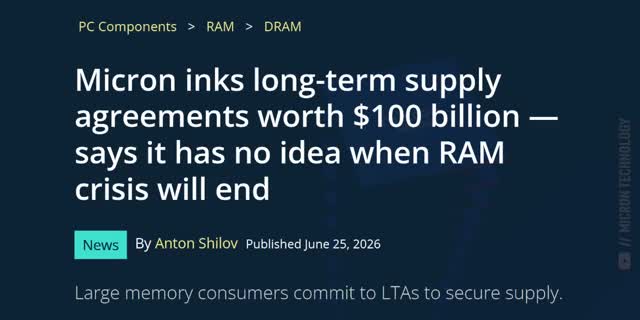
Sandisk disclosed roughly $42 billion in minimum contract value that they signed over the last quarter. Those contracts cover over a third of the memory by bits that Sandisk expects to make this fiscal year. And Micron has 16 strategic customer agreements that represent over $100 billion in minimum contract value. That covers roughly 20% of their DRAM and a third of their NAND flash volume. These are huge contracts that prevent these huge upsides. So memory stocks went down over the last few weeks. But look what's happening now. The big reason for the current drawdown is that China might be able to make their own memory with homegrown DUV lithography machines. That increases supply, which means memory prices should fall.
But these same contracts that prevent memory companies from enjoying the upsides protect them from falling prices too. Exactly the thing the whole market is worried about. SK Hynix stock is down by around 25% over the last couple weeks on the Nasdaq, and around 50% in the past month on the Korea Exchange. Micron stock is down by around 35% over the last month, and 25% in the last week alone. And SanDisk stock has literally been cut in half over the last 30 days, even though contracts protect all three companies from falling prices. And China is still years away from using their DUV lithography machines to make competitive chips at scale. I'm not saying there's zero risk for these memory stocks, but I am saying that it's way too early to price those risks in, at least in my opinion.
Another risk that's being priced in way too early is Metacompute. Earlier this month Bloomberg reported that Meta is planning their own cloud business called MetaCompute to rent out any extra AI infrastructure that they build to outside companies The report sent Meta stock up by almost 9 in a single trading day, while knocking down neocloud stocks like CoreWeave, Nebius, and Iren by 14-17% each. But the bleeding hasn't stopped for these companies. CoreWeave is down by over 35% this month, and almost 25% in the last week alone. IREN is also down by over 35%, and Nebius is down by over 40%, marking some of the sharpest declines these three companies have ever seen. It's worth asking the same question here.
Metacompute Risk
Should these three companies really be down by this much? Let's think about it from first principles. Neocloud companies rent compute capacity to companies that want AI, but don't want to spend billions of dollars building and maintaining their own physical infrastructures. So, these neoclouds go out and secure grid-connected power, build or buy data centers, fill them with racks of GPUs and networking gear, and make their money back by renting it all out once everything's all online. That means neoclouds have to risk a lot of money up front and hope that there will still be enough demand when everything is up and running.

If the company is still young and unprofitable, they need to borrow that money, usually by taking out loans at high interest rates or diluting shareholders, both of which are bad for the stock. But Meta Platforms doesn't have that problem, since it's already a trillion-dollar tech giant with massive margins. So Meta can build as much compute capacity as they want, and rent out whatever they don't end up using without having to raise any extra capital or take on loans with bad terms. So, it's game over for the neoclouds, right? Meta gets all of the upside with almost none of the downsides or the risks. Well, not exactly. First, Meta just reported earnings on July 29th. On their previous earnings call, Mark Zuckerberg said that entering the cloud business is definitely on the table.
Cloud Business
On this one, he said that they're getting offers to rent out their compute at a big premium over what they paid for it. But he thinks that it would be foolish to just sell their compute for short-term profits. Meta can make much more money by selling finished intelligence services like agentic models and coding tools instead of renting out raw hardware. As a result, Meta is using all of their servers themselves and don't have any extra compute capacity to rent out. On top of that, Iren and Nebius both signed billion-dollar contracts after this report came out. On July 14th, Nebius agreed to sell more than a billion dollars of compute capacity to Reflection AI. The contract runs through 2029 for access to NVIDIA's GB300 Blackwell Ultra chips.

Then on July 20th, IREN signed $2.8 billion in new multi-year AI cloud contracts and raised their year-end target for their revenue run rate. And don't forget that Meta actually has $35 billion committed to CoreWeave and up to $27 billion in additional contracts with Nebius. That makes Meta a net buyer of NeoCloud Compute, not a net seller, like the market is pricing in right now. So Metacompute is a great way for them to hedge against overspending on their own AI data centers, but it's not happening anytime soon. That's why I'm still buying IREN, Nebius, and Coreweave, especially as their prices continue to fall. And I'm not the only one.
On July 20th, Nvidia filed a disclosure with the SEC stating that they own over 22 million shares of Nebius, which works out to around 9.3% of the company. To me, that means Nvidia isn't just betting on Nebius, but on the bigger idea that neoclouds are worth investing in directly. And that brings me to the third group of stocks, quantum computing. And if you feel I've earned it, consider hitting the like button and subscribing to the channel. That really helps and it lets me know to make more videos like this.

Thanks, now let's talk about IonQ, D-Wave and Regetti, since they're all down by 30 to 40 percent over the last few weeks on july 13th the same day that halted the korea exchange all three quantum computing companies went down by close to 10 percent no news no earnings misses and no delays so let ask the same question for a third time Should these three stocks really be down by this much First there no meaningful connection between quantum computing hardware and Korean memory. These machines don't compete with memory, they don't buy it in large volumes, and they don't sell to the same customers. Quantum computing stocks simply moved with the rest of the market. And second, all three companies had major developments during this drawdown.
Quantum Computing
And one day later, IonQ cleared the final regulatory hurdle to acquire Skywater Technology, an American semiconductor foundry with the deal expected to close right as I publish this video. So, IonQ is spending money on securing a fully domestic supply chain to accelerate their own roadmap. All three companies report earnings in early August, so let me know in the comments if you want me to follow up with another video focused on quantum computing. Alright, here's a table summarizing everything I've covered. As you read through it, keep a few things in mind. I built this table myself and I tried to keep each row as apples to apples as I could. But, it's not perfect.
For example, I'm showing price changes over the last month, but SK Hynix didn't list on the Nasdaq until July 10th, so I'm using their price on the Korea exchange instead, which is about a day ahead. And all these companies have different fiscal years, so I'm using their trailing 12-month revenue growth. And of course, they all have different contract lengths and terms with different customers and fundamentally different technologies. So basically, take this as a solid summary table, but not as official audited numbers. Here's what jumps out at me after putting this all together. Every one of these stocks is down by between 30 and 55% in a single month. Memory makers, AI cloud companies, and quantum computing.

Three completely different markets, with three completely different kinds of milestones and risks. And almost every single one of them has grown their revenues by triple digits nebius grew by 453 percent ionq grew by 335 these are not companies in trouble their stocks got cut in half while their businesses doubled and then there's ruggedi with revenues down 34 year over year but that number is hiding something big their most recent quarter was actually up 199 driven by on-premises system sales and government contracts. Early-stage quantum revenue is always spiky because it comes from individual system sales, research awards, and cloud access milestones instead of steadily recurring revenue. A big system can ship in one quarter and not in the next.
So if you're investing in quantum computing, you already know it's going to be a bumpy long-term ride. And speaking of bumpy, one quick note about this drawdown. If you look at the price action over the last month, You'll find plenty of days where stocks ripped 10, 15, or even 20% higher in a single day, only to lose it all again the following week. A green day in the middle of a drawdown can feel like the bottom, and sometimes it is, but sometimes it's just a breather before the next leg down. That's why I always dollar cost average into these positions, and why I always keep some money on the side in case things go lower. That's a great way to get rich without getting lucky. And if you want to see even more stocks I'm buying to get rich without getting lucky, check out this video next.
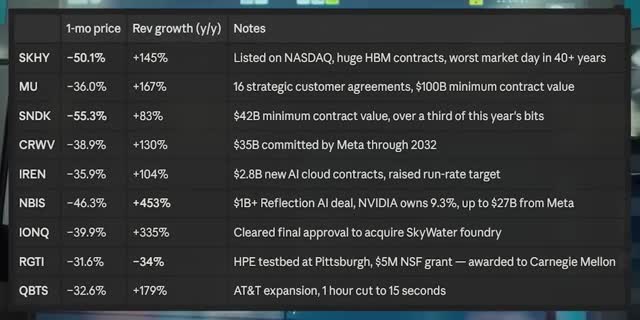
Table of Contents
1. Metacompute Risk
2. Cloud Business
3. Quantum Computing
Either way, thanks for reading and until next time, this is TickerSymbol: YOU. My name is Alex reminding you that the best investment you can make is in you.
Key Takeaways
Here are the key points to take away from this article:
- AI stocks have lost over a trillion dollars in combined value over the last two weeks.
- The KOSPI is down by over 15% in the last few days, and more than 30% in the last month alone.
- China has begun mass producing its own Immersion DUV lithography machines, which could increase supply and decrease memory prices.
- Memory companies such as SK Hynix, Sandisk, and Micron have huge contracts that prevent them from enjoying upsides and protect them from falling prices.
- Neocloud companies such as CoreWeave, Nebius, and Iren are down by over 30% due to Meta's plan to rent out AI infrastructure.
- Quantum computing companies such as IonQ, D-Wave, and Rigetti are down by 30 to 40% despite having major developments during the drawdown.
Checkout our YouTube Channel
Get the latest videos and industry deep dives as we check out the science behind the stocks.